

Performance Testing with LoadRunner – Beginner to Advanced Live Training
(TruClient Protocol, Dynatrace & AppDynamics Grafana, CI/CD Pipeline – Jenkins, Virtual Table Server, Load Balancer algorithms, Truclient, GC Mechanism, Webservices)
Our OpenText LoadRunner Training is a comprehensive performance testing course designed to help you master load testing, stress testing, and performance engineering using industry-standard tools. This course provides hands-on experience with LoadRunner VuGen, Controller, and Analysis, covering scripting, correlation, parameterization, runtime settings, and test execution. You will work on real-time performance testing scenarios involving Web (HTTP/HTML) and Web Services (HTTP/XML) applications. The training focuses on end-to-end performance testing life cycle, workload modeling, SLA analysis, and bottleneck identification. Ideal for manual testers, automation testers, and QA professionals, this OpenText LoadRunner course also includes interview preparation, real-world projects, and career guidance.
Disclaimer: “Isha Training Solutions is not affiliated with, sponsored or authorized by OpenText”
Why Learn OpenText LoadRunner?
- High industry demand for professionals skilled in performance testing and load testing across enterprise applications
- Learn OpenText LoadRunner end-to-end, including VuGen, Controller, and Analysis components
- Gain hands-on experience in load testing, stress testing, and endurance testing with real-time scenarios
- Master the complete performance testing life cycle, from workload modeling to SLA analysis
- Identify and analyze application performance bottlenecks using detailed reports and graphs
- Widely used tool for Web (HTTP/HTML) and Web Services (HTTP/XML) performance testing
- Ideal upskilling path for manual testers, automation testers, and QA engineers
- Improves interview readiness, career growth, and opportunities in performance engineering roles
About the Instructor :
| Saravanan is a seasoned Performance Testing and Performance Engineering professional with over 14 years of industry experience. Throughout his career, he has developed deep expertise in performance testing, application performance monitoring, observability, and performance engineering practices across diverse enterprise environments.
Driven by a passion for mentoring and knowledge sharing, Saravanan has spent more than 7 years delivering professional technical training programs. He has successfully trained over 700+ students through both online and classroom sessions, helping professionals build practical, job-ready skills. His areas of expertise include industry-leading tools and technologies such as LoadRunner (Certified), JMeter, NeoLoad (Certified), Dynatrace (Certified), AppDynamics, and Performance Engineering. He is widely recognized for combining real-world project experience with hands-on training methodologies that enable learners to confidently apply concepts in enterprise environments. In addition to his performance engineering expertise, Saravanan holds the Microsoft Azure Fundamentals (AZ-900) certification and continuously explores modern observability and cloud monitoring practices. He currently works with Accenture in India and actively contributes to the technology community through training, mentoring, and thought leadership.
|
| I am able to Record, Replay back, Add transactions & Add Check Points, then why should I take this course? This course is much deeper than that. Students reported that they were able to troubleshoot the issues by themselves after attending the course. Also, reported that the course helped them to break the interviews confidently. Lots of C functions, LR functions, conversions etc…will be discussed. If you are lead, you will understand what NFR’s to collect from client and exact process to follow during project implementation. (PTLC). |
Live Sessions Price:
Offer price after discount is 300 USD 259 109 USD Or USD13000 INR 12900 INR 8900 Rupees.
OR
Free Demo Session:
16th November @ 7:30 PM – 8:30 PM (IST) (Indian Timings)
16th November @ 9:00 AM – 10:00 AM (EST) (U.S Timings)
16th November @ 2:00 PM – 3:00 PM (BST) (UK Timings)
Class Schedule:
For Participants in India: Monday to Friday @ 7:30 PM – 8:30 PM (IST)
For Participants in the US: Monday to Friday @ 9:00 AM – 10:00 AM (EST)
For Participants in the UK: Monday to Friday @ 2:00 PM – 3:00 PM (BST)
What student’s have to say about Sarvanan:
| Thanks to Isha training for offering such a valuable training. Really Kumar sir is giving life to many of the students through this training Institute. Thank you Saravanan sir, It was a great course journey. You explained each and every topic very well.-Ramya
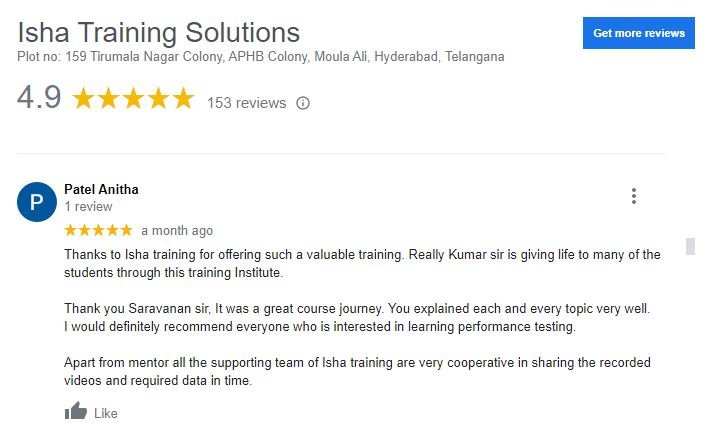
I would definitely recommend everyone who is interested in learning performance testing. Apart from mentor all the supporting team of Isha training are very cooperative in sharing the recorded videos and required data in time. -Patil Anitha Its a good topic to learn and I have gained a lot of knowledge from this and as a performance tester I think it would help me a lot in the future for becoming an expert in this. – Prashanth E. Trainer is giving excellent class. Good knowledge on subject – Mamdouh Excellent explanation of Performance testing topics. Very useful for beginners as well as for the experienced people to revise the basics – Anonymized Its a great course and absolutely love how the teacher explains the course very clear and precise. I will be definitely be taking other courses in the future!. – Michael S. The course is really helpful no prior knowledge is needed to understand. I have gotten to understand each and everything till now. Thankyou Sarvanan Sir for providing such a valuable content. – Sony S. At first I feel its not good, but after going through few sections i realized its very valuable content. Thank you – Hemasekhar |
What will I Learn by end of this course?
- Understand the complete performance testing life cycle and non-functional testing concepts
- Gain hands-on experience with OpenText LoadRunner VuGen, Controller, and Analysis
- Create and enhance LoadRunner scripts using correlation, parameterization, and checkpoints
- Perform load testing, stress testing, spike testing, and endurance testing on real-world applications
- Design and execute load test scenarios with proper workload modeling and runtime settings
- Analyze performance test results, SLA metrics, and identify application bottlenecks
- Execute performance tests for Web (HTTP/HTML) and Web Services (HTTP/XML) applications
- Interpret reports and graphs to provide performance optimization recommendations
- Prepare for LoadRunner performance testing interviews with real-time project exposure
Salient Features
- 30+ hours of high-quality on-demand training videos covering end-to-end OpenText LoadRunner concepts
- Live real-time project after course completion to gain hands-on industry experience
- Course Completion Certificate from Isha Training Solutions
- Frequently asked LoadRunner interview questions covered throughout the course for strong interview readiness
- 10+ hours of self-paced recorded sessions on TruClient protocol
- 8+ hours of self-paced recorded sessions on Web Services performance testing
Who can enroll for this course?
- Manual Testers looking to upgrade their skills into performance testing and load testing
- Automation Testers who want to expand into OpenText LoadRunner performance engineering
- QA Engineers and QA Analysts aiming to specialize in performance and non-functional testing
- Software Test Engineers seeking hands-on experience with enterprise performance testing tools
- Developers interested in understanding application performance bottlenecks and optimization
- Freshers and graduates aspiring to start a career in performance testing using OpenText LoadRunner
- IT professionals planning a career transition into performance engineering roles
Course syllabus:
- Architecture Basics
- Introduction to Performance Testing
- Performance Testing Process and Life Cycle.
- Proof of Concept
- Non Functional Requirements
- Test Plan
- Work Load Modelling…
4. Introduction to Load Runner
- Installation
- Components of LR
- Record and Replay scripts in LR
- Features of Vugen tool
- Best scripting practices in Vugen
- Transaction Names Naming Conventions
- Understanding the script and excluding unnecessary requests
- Learning important inbuilt functions
- Multiple Actions
- Debug options
- Recording vs Replay etc…
- Run Time Settings
- Run Logic Tree
- Pacing
- Think Time
- Log
- Speed simulation and Browser Emulation
- Proxy settings
- HTML vs URL based recording
- Adding sub transactions
- Check Points
- Text Check Point
- Image check Point
- Introduction to C Language
- Variables
- Data Types
- If Statements
- Loops and conditions
- Select Case statements
- Functions
- C language Functions and LR Functions
- lr_save_int()
- lr_save_string()
- lr_param_sprintf()
- atoi()
- itoa()
- lr_eval_string() etc…
- SaveCount parameter in text check point
- Advanced C Language
- Writing Data to file
- Reading Data from File
- Real time challenges in scripting
- Correlation
- What is correlation?
- Why correlation is required?
- Types of correlation
- web_reg_save_param_ex() function
- Multiple techniques to implement correlation
- lr_paramarr_random() function
- lr_paramarr_idx() function
- Using regular expressions
- web_reg_save_param_regexp() function
- Parameterization
- Why Parameterization?
- Types of Parameters
- Parameter combinations
- Simulate Parameters
- Best Practices
- Controller
- Scenario creation ( Load, Endurance, Scalability)
- Scenario Types
- Basic Schedule and Real Time Schedule
- By Group and By Scenario
- Executing a load test
- Run Time Settings and SLA’s
- Load Generators
- Monitoring Graphs and Messages in controller
- Analysis
- Summary Report
- 90th Percentile
- Transactions summary
- HTTP response codes
- Throughput vs Hits per second
- Users vs Hits per second
- Throughput vs Response Time
- Merging Graphs
- Generating reports
- Identifying Bottlenecks…
- Analyzing results and providing observations
- Performance Test Results / Analysis
- Collate and analyze the load test data
- Generate reports and graphs for a test set
- Download the load test results files
- Results Generation
- Drafting email with all observations to
- Interview Questions with Answers
- Scripting practice on 5
- Grafana Integration
Bonus Topics:
- Fiddler, HAR file scripting
- APM tools introduction.
- AppDynamics and its metrics to identify bottlenecks
- Dynatrace and its metrics to identify bottlenecks
- CI CD: Jenkins
- Triggering Load runner local scenarios from Jenkins
- Additional Session on Truclient
- Discussion about Thread dumps and Heap Dumps
- Load Balancer Algorithms discussion
- Discussion on Garbage Collection Mechanism
API (WebServices) Performance Testing Using LoadRunner Training (SOAP & RESTful) (8+ hours Self-paced videos will be provided):
- Introduction to Web Services
- What is Web Service?
- Web Services Demo
- Purpose of Web Services
- Interoperability of Web Services
- Web Applications where Web Services are used.
- Handout / Course Material for the course
- Types of Web Services
- Introduction to SOAP WS
- What is SOAP Protocol?
- UDDI
- Introduction to RESTful Web Services
- Difference Between SOAP WS and RESTful WS
- SOAP Web Services
- Introduction to SOAPUI Tool
- Installation of SOAPUI Tool
- Using SOAPUI Tool
- Different Ways of Creating VuGen Scripts for SOAP WS
- Different Ways of Creating Script Via VuGen
- Creating SOAP WS scripts Using HTTP/HTML Protocol
- Create Script Using Web_custom_Request
- Web_custom_Request – Fix Compilation Errors
- Web_custom_Request – Fix Execution Errors
- Web_custom_Request – Execution
- Creating VuGen Script Via Recording
- SOAP VuGen Scripts – Enhancements
- Transaction Points
- CheckPoints -Introduction
- Insert CheckPoints
- Execute Script after inserting CheckPoints
- CheckPoints – Misc Information
- ErrorHandling 1
- ErrorHandling 2
- SOAP VuGen Scripts -Parameterization – Further Enhancements
- Why Parameterization?
- What is Parameterization?
- Implementing Parameterization?
- Script Execution
- Where can we implement Parameterization
- SOAP VuGen Scripts -Correlation- Further Enhancements
- Sample SOAP Used for Correlation Demonstration
- Why Correlation?
- Implementing Correlation
- Script Execution with Correlation
- Final Script with all the enhancements – Part1
- Final Script with all the enhancements – Part2
- Correlation to Capture any Value
- Correlation to Capture Multiple Values
- Explore Correlation arguments
- Creating SOAP WS scripts Via Web Services Protocol
- All Recording Options for SOAP using Web Services Protocol
- Sample Projects Walk-thru
- Creating VuGen script using “Import WSDL”
- Execute Script
- Installation of WSE2 & WSE3 Patches
- Output Arguments 1
- Output Arguments 2
- Output Arguments 3
- WebServices Protocol — Misc Enhancements
- Enhancements -Inserting Transactions
- Enhancements -Parametrization
- Enhancements -ThinkTime
- WebServices Protocol — Enhancements – Error Handling
- LR_XML_FIND LR Function
- Error_Handling using LR_XML_FIND
- Parameterization & LR_XML_FIND
- WebServices Protocol — Enhancements – Handling Dynamic Values
- How to Handle Dynamic Values in web services protocol
- Input and output arguments
- lr_xml_get_values
- lr_xml_get_values – SelectALL Argument
- lr_xml_extract
- Final Professional script
- SOAP – WebServices Protocol — Other Options for creating scripts
- Via Recording
- Via Importing SOAP File
- RESTful Web Services
- RESTful WebServices – Introduction
- POSTMAN Tool – Installation
- Sample RESTful Web Service – Part1
- Access Rest Services from POSTMAN
- VUGEN Script for GET Request
- VUGEN Script for POST Request
- VUGEN Script for PUT Request
- RESTful WS — Enhancements
- RESTful WS — Parameterization- Part1
- RESTful WS — Parameterization- Part2
- RESTful WS — Correlation
- Misc Section – C Programming
- Introduction
- DataType – Integer – Part1
- DataType – Integer – Part2
- DataType – String
- LR Parameter
- Conversions – Part1
- Conversions – Part2
- Conversions – Part3
TruClient Protocol Using LoadRunner(10+ hours Self-paced videos will be provided):
- Introduction
- Script Recording and Replay
- Run time Settings
- Inserting Transactions to capture response times
- Parameterization
- Truclient Custom Scripting
- Event Handlers
- Object Identification Techniques
- True client inbuilt Functions
- Flow control and miscellaneous
- Customize your TruClient script via JavaScript
- Functions and Libraries
- VTS integration with LR
- Utilities
- Tricks and Tips
- Handling dynamic table with True client protocol
- Dialogue box handling in Truclient
- File upload scenario in Truclient
- Clear cache and cookie in Truclient
- Scripting and Execution of web based application in Controller
- Report Analysis
- Queries and doubts clearing session.
Frequently Asked Questions (FAQs)
1. What is OpenText LoadRunner?
OpenText LoadRunner is a leading performance testing tool used for load testing, stress testing, and endurance testing of web and enterprise applications. It helps identify performance bottlenecks before applications go live.
2. Is OpenText LoadRunner still in demand?
Yes, OpenText LoadRunner is widely used by enterprises for performance and load testing, especially for large-scale web and web services applications, making it a highly in-demand skill.
3. Do I need prior experience to learn OpenText LoadRunner?
No prior LoadRunner experience is required. Basic knowledge of software testing concepts is sufficient. The course starts from performance testing fundamentals and gradually moves to advanced topics.
4. What skills will I gain from this LoadRunner course?
You will gain hands-on skills in performance testing life cycle, LoadRunner scripting, correlation and parameterization, scenario design, test execution, and result analysis using SLA metrics.
5. Does this course include real-time projects?
Yes, the course includes a live real-time performance testing project that helps you apply LoadRunner concepts to real-world scenarios.
6. Which protocols are covered in this course?
The course covers Web (HTTP/HTML), Web Services (HTTP/XML), and TruClient, protocols with practical examples.
7. Will I get a course completion certificate?
Yes, you will receive a Course Completion Certificate from Isha Training Solutions after successfully completing the course.
8. Does the course help with interview preparation?
Absolutely. The course covers frequently asked LoadRunner interview questions, real-time use cases, and practical scenarios to improve interview readiness.
9. Is this course suitable for freshers?
Yes, this OpenText LoadRunner training is suitable for freshers, graduates, and experienced professionals who want to build a career in performance testing and performance engineering.
10. What career opportunities are available after completing this course?
After completing the course, you can apply for roles such as Performance Test Engineer, Load Test Engineer, QA Performance Engineer, and Performance Analyst.
How can I enroll to this Course?
OR
For any other details, Call me or Whatsapp me on +91-9133190573
Live Sessions Price:
Offer price after discount is 300 USD 259 109 USD Or USD13000 INR 12900 INR 8900 Rupees.
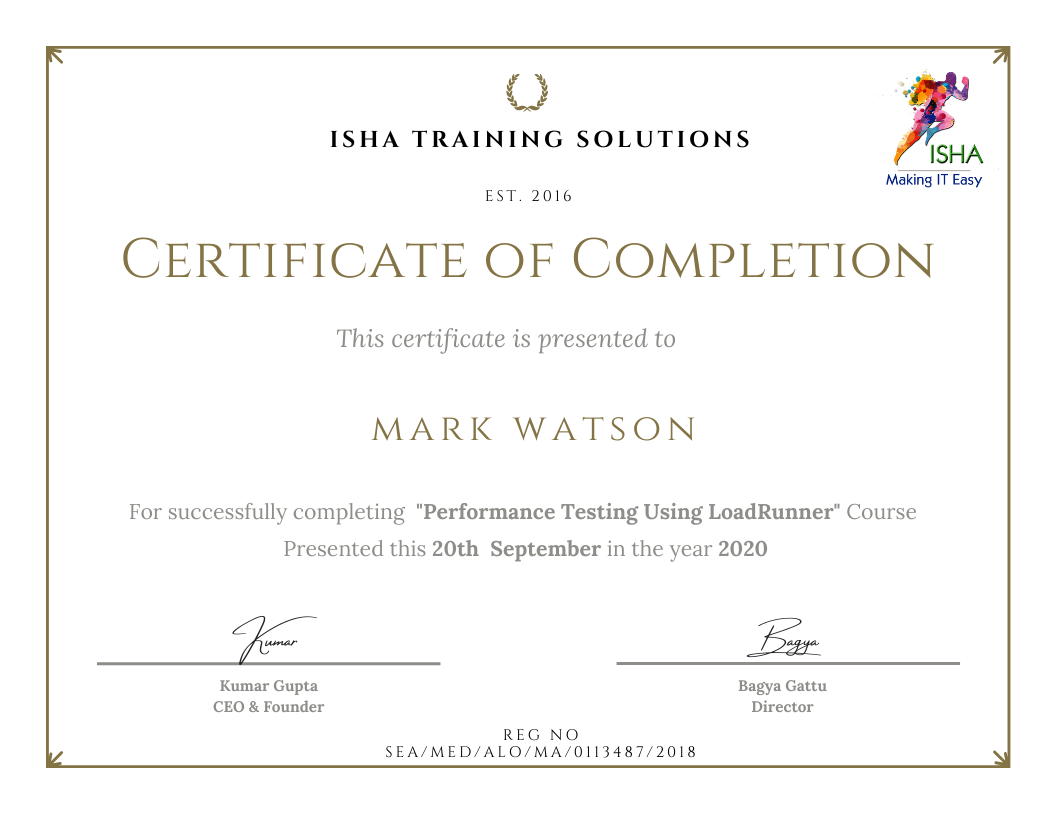
Sample Course Completion Certificate:
Your course completion certificate looks like this……
Course Policy :
Once payment is made, no refund will be provided.
If you do not attend the course, the payment cannot be transferred to another batch.
Course repetition is not allowed for missed sessions
We request all learners to attend the scheduled sessions regularly and make the most of their learning journey. Thank you for your understanding and continued support.
Reviews:
Course Features
- Lectures 77
- Quiz 0
- Duration 35 hours
- Skill level All levels
- Students 1290
- Assessments Yes
- 19 Sections
- 77 Lessons
- 35 Hours
- Curriculum for Performance Testing Using LoadRunner2 Items
- Performance Testing Process and Life Cycle.4 Items
- Introduction to Load Runner4 Items
- Best scripting practices in Vugen6 Items
- Run Time Settings6 Items
- HTML vs URL based recording1 Item
- Check Points2 Items
- Introduction to C Language5 Items
- C language Functions and LR Functions7 Items
- Advanced C Language3 Items
- Correlation9 Items
- Parameterization5 Items
- Controller5 Items
- Monitoring Graphs in controller0 Items
- Analysis10 Items
- Analyzing results and providing observations0 Items
- Interview Questions with Answers0 Items
- Bonus Topics:8 Items
- 18.1Fiddler, HAR file scripting
- 18.2APM tools introduction.
- 18.3AppDynamics and its metrics to identify bottlenecks
- 18.4CI CD: Jenkins
- 18.5Triggering Load runner local scenarios from Jenkins
- 18.6Additional Session on Truclient
- 18.7Discussion about Thread dumps and Heap Dumps
- 18.8Load Balancer Algorithms discussion
- Note: Recorded sessions of web services will be provided along with this course.0 Items


