
Platform Engineering Mastery Program – Live Training (Basics to Advanced)
(Build Scalable Internal Developer Platforms | Master Kubernetes, CI/CD, IaC & Cloud-Native Engineering)
Platform Engineering is the discipline of designing, building, and maintaining the shared infrastructure, tooling, and workflows that development teams rely on to ship software faster and more reliably. It is one of the fastest-growing roles in the DevOps ecosystem.
A Platform Engineer acts as the bridge between infrastructure and development — creating Internal Developer Platforms (IDPs) that reduce cognitive load, enforce standards, and enable self-service capabilities across engineering teams. According to Gartner, 80% of large engineering organizations will have dedicated platform engineering teams by 2026, making this one of the highest-demand specializations in the industry. At Isha Training Solutions, our Platform Engineering course combines our deep roots in Performance Testing, SRE, APM, and Automation with the modern platform toolchain — giving you a uniquely complete perspective that most programs miss.
💡 You won’t just learn tools — you’ll learn how to think like a Platform Engineer.
🚀 Why Platform Engineering is the Future?
🔥 Exploding Demand – Organizations are rapidly adopting Platform Engineering to accelerate software delivery.
⚡ Developer Efficiency – Enables developers to focus on innovation rather than infrastructure management.
☁️ Cloud-Native Revolution – Powers modern applications with Kubernetes, containers, and cloud technologies.
🤖 Automation-Driven Workflows – Automates deployments, provisioning, monitoring, and operations.
🏢 Enterprise Adoption – Enterprises are investing heavily in Internal Developer Platforms (IDPs).
🌟 About the Instructor – Kiran
|
Trainer – Kiran (Platform Engineering Expert) Kiran is a highly experienced technology professional with strong expertise in Platform Engineering, DevOps, Cloud Computing, Kubernetes, Docker, CI/CD, Infrastructure as Code (IaC), and Automation. With extensive real-world experience in designing and implementing scalable enterprise platforms, he has helped organizations improve developer productivity, streamline software delivery, and accelerate cloud adoption. His training approach is practical, hands-on, and focused on real-time industry use cases, ensuring participants gain both technical knowledge and implementation skills. Kiran is passionate about mentoring professionals and helping them build successful careers in the rapidly growing field of Platform Engineering. 🎯 His training style focuses on:
|
Live Sessions Price:
For LIVE sessions – Offer price after discount is 300 USD 259 119 USD Or USD13000 INR 12000 INR 8900 Rupees
OR
Free Demo Session:
22nd June @ 9:00 PM – 10:00 PM (IST) (Indian Timings)
22nd June@ 11:30 AM – 12:30 PM (EST) (U.S Timings)
22nd June@ 4:30 PM – 5:30 PM (BST) (UK Timings)
Class Schedule:
For Participants in India: Monday to Friday @ 9:00 PM – 10:00 PM (IST)
For Participants in the US: Monday to Friday @ 11:30 AM – 12:30 PM (EST)
For Participants in the UK: Monday to Friday @ 4:30 PM – 5:30 PM (BST)
⭐ What Students Say About Instructor Kiran
|
👨 Amit Sharma: 👨 Sandeep Reddy: 👩 Fatima Khan: 👩 Ayesha Begum: 👩 Nusrat Ali: |
⭐ Salient Features
- Industry-Oriented Curriculum
- Hands-On Labs & Real-Time Projects Cloud-Native & Kubernetes-Focused Learning
- CI/CD, DevOps & Automation Best Practices
- Infrastructure as Code (IAC) Implementation
- Internal Developer Platform (IDP) Concepts
- Interview Preparation & Resume Guidance
- Session Recordings for Revision
- Career Support & Industry Insight
🎯 Who Can Enroll for this Course?
- Anyone Looking to Build a Career in Platform Engineering
- Freshers with Basic Linux & Cloud Knowledge
- IT Operations Professionals
- Technical Leads & Architects
- Software Developers
- Kubernetes & Docker Enthusiasts
- Cloud Engineers
- DevOps Engineers
🚀 What Will I Learn by the end of this Course?
- Understand Platform Engineering Fundamentals & Best Practices
- Build and Manage Internal Developer Platforms (IDPs)
- Design Cloud-Native Architectures Using Kubernetes
- Implement CI/CD Pipelines for Faster Software Delivery
- Automate Infrastructure with Infrastructure as Code (IaC)
- Deploy and Manage Applications Using Docker & Containers
- Configure Monitoring, Logging, and Observability Solutions
- Implement Security and Governance Best Practices
- Improve Developer Experience Through Self-Service Platforms
- Work on Real-Time Enterprise Platform Engineering Scenarios
- Be Ready for Platform Engineering, DevOps, Cloud, and SRE Roles
Course Syllabus:
🔹CHAPTER 1: Platform Engineering Foundations
- What is Platform Engineering vs DevOps vs SRE
- Internal Developer Platform (IDP) concepts
- Golden Paths and Paved Roads
- CNCF landscape overview
- Team Topologies & Platform Team models
- Developer Experience (DevEx) principles
- Platform Engineering maturity model
- Platform KPIs and DORA metrics
🔹CHAPTER 2: Containers & Kubernetes Deep Dive
- Docker fundamentals and best practices
- Kubernetes architecture and components
- Kubernetes Networking — Services, Ingress
- Horizontal & Vertical Pod Autoscaling
- Container security and image scanning
- Deployments, Stateful Sets, DaemonSets
- RBAC, Admission Controllers, Namespaces
- Kubernetes Operators pattern
🔹CHAPTER 3: Infrastructure as Code
- Terraform fundamentals and HCL language
- AWS, Azure, GCP provisioning with Terraform
- Ansible for configuration management
- Policy as Code with OPA/Confutes
- Terraform modules and remote state
- Pulu mi — Infrastructure as real code
- Cross plane — Kubernetes-native Isac
- Drift detection and remediation
🔹 CHAPTER 4: CI/CD Pipeline Engineering
- Jenkins advanced — shared libraries, agents
- GitHub Actions — reusable workflows
- Artifact management — JFrog Artifactory, Nexus
- SonarQube code quality gates
- GitLab CI/CD pipelines from scratch
- Tektone — Kubernetes-native pipelines
- Pipeline security and SAST/DAST integration
- Pipeline observability and failure analysis
🔹CHAPTER 5: Gi tops & Continuous Deployment
- Gi tops principles and operator pattern
- Flux CD — Gi Repository, Customization
- Customize for environment overlays
- Flagger for automated progressive rollouts
- Argo CD — installation, apps, sync strategies
- Helm chart development and repositories
- Progressive delivery — Canary, Bluegreen
- Multi-cluster Gi tops management
🔹CHAPTER 6: Observability & Platform Monitoring
- Three Pillars: Metrics, Logs, Traces
- Grafana dashboards and alerting
- Distributed tracing with Jaeger & Tempo
- Datadog, Dynatrace platform integration
- Prometheus — Prom, alerting rules
- Open Telemetry — instrumentation & collectors
- Loki for log aggregation
- SLO/SLI/SLA definition and alerting
🔹CHAPTER 7: Service Mesh & Networking
- Service Mesh concepts and use cases
- Linked — lightweight service mesh setup
- Network policies in Kubernetes
- Ingress controllers — Nginx, Trae Fik
- Istio — traffic management, MTLS
- API Gateway — Kong, Nginx, Envoy
- DNS management — Externals, Corden’s
- Load balancing strategies and circuit breaking
🔹CHAPTER 8: Platform Security & Compliance
- Zero-trust security model for platforms
- Kubernetes RBAC and ABAC deep dive
- Falco — runtime threat detection
- Container image signing and verification
- Hashi Corp Vault — secrets management
- OPA / Gatekeeper for policy enforcement
- Supply chain security (SLSA, Instore)
- CIS benchmarks and compliance scanning
🔹CHAPTER 9: Internal Developer Portal — Backstage
- Backstage architecture and software catalog
- Software Templates — scaffolding golden paths
- Integrating Backstage with Kubernetes
- Self-service workflows design
- Tech Docs— documentation as code
- Backstage plugins ecosystem
- Port IDP as Backstage alternative
- Developer portal governance and adoption
🔹CHAPTER 10: Cloud-Native & Multi-Cloud Platforms
- AWS EKS — managed Kubernetes setup
- Cloud cost optimization and FinOps
- Serverless platforms — Native, Open Faas
- Disaster recovery and backup strategies
- Azure AKS and GCP GKE deep dive
- Multi-cluster federation strategies
- Platform networking in cloud environments
- Platform migration patterns
🔹CHAPTER 11: Capstone Project — Build Your Own IDP
- End-to-end IDP design document
- Full Gi tops pipeline with Argo CD
- Complete observability stack deployment
- Platform runbooks documentation
- Multi-team Kubernetes cluster setup
- Backstage portal with real integrations
- Security policies and Vault integration
- Live project review and certification
How can I enroll for this course?
OR
For any other details, Call me or Whatsapp me on +91-9133190573
For LIVE sessions – Offer price after discount is 300 USD 259 119 USD Or USD13000 INR 12000 INR 8900 Rupees
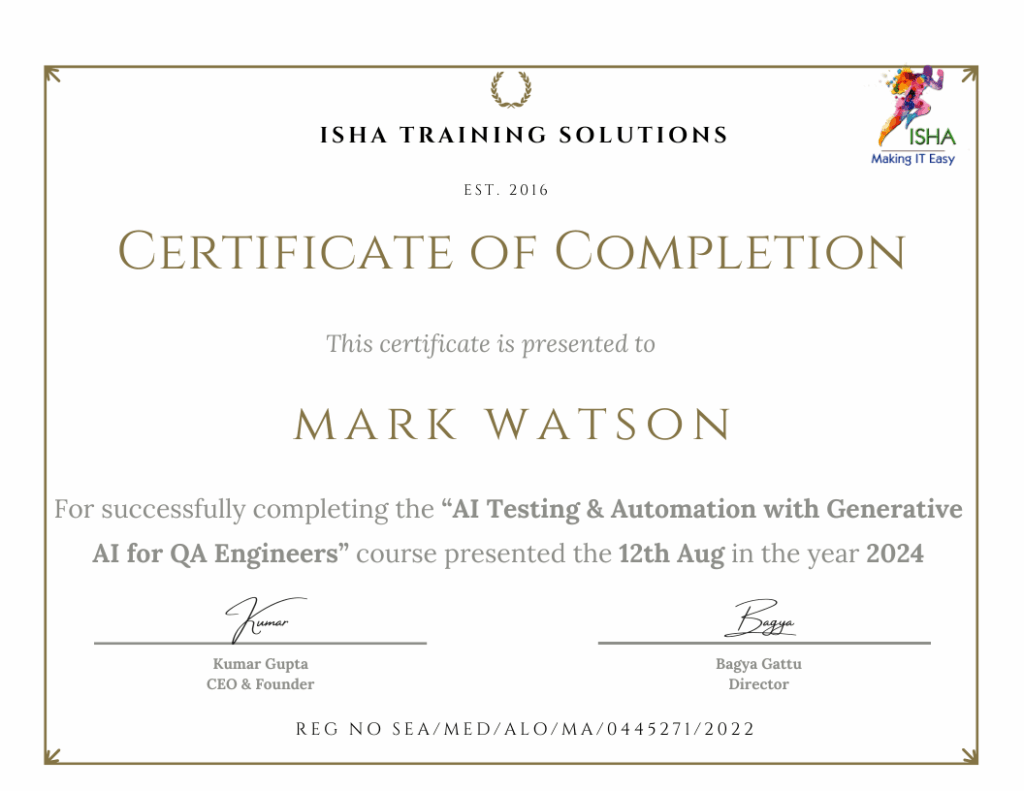
Sample Course Completion Certificate:
Your course completion certificate looks like this….
Important Note:
To maintain the quality of our training and ensure a smooth learning experience for all participants, we do not allow batch repetition or switching between courses.
To reiterate, moving from one course to another or shifting from one trainer to another (even if it is the same course) is not possible. Changing batches or trainers in any form is strictly not permitted.
We request all learners to attend the scheduled sessions regularly and make the most of their learning journey. Thank you for your understanding and continued support.
Course Features
- Lectures 88
- Quiz 0
- Duration 10 weeks
- Skill level All levels
- Language English
- Students 0
- Assessments Yes
- 11 Sections
- 88 Lessons
- 10 Weeks
- 🔹CHAPTER 1: Platform Engineering Foundations8
- 1.1What is Platform Engineering vs DevOps vs SRE
- 1.2Internal Developer Platform (IDP) concepts
- 1.3Golden Paths and Paved Roads
- 1.4CNCF landscape overview
- 1.5Team Topologies & Platform Team models
- 1.6Developer Experience (DevEx) principles
- 1.7Platform Engineering maturity model
- 1.8Platform KPIs and DORA metrics
- 🔹CHAPTER 2: Containers & Kubernetes Deep Dive8
- 2.1Docker fundamentals and best practices
- 2.2Kubernetes architecture and components
- 2.3Kubernetes Networking — Services, Ingress
- 2.4Horizontal & Vertical Pod Autoscaling
- 2.5Container security and image scanning
- 2.6Deployments, StatefulSets, DaemonSets
- 2.7RBAC, Admission Controllers, Namespaces
- 2.8Kubernetes Operators pattern
- 🔹CHAPTER 3: Infrastructure as Code8
- 3.1Terraform fundamentals and HCL language
- 3.2AWS, Azure, GCP provisioning with Terraform
- 3.3Ansible for configuration management
- 3.4Policy as Code with OPA/Conftest
- 3.5Terraform modules and remote state
- 3.6Pulumi — Infrastructure as real code
- 3.7Crossplane — Kubernetes-native IaC
- 3.8Drift detection and remediation
- 🔹 CHAPTER 4: CI/CD Pipeline Engineering8
- 4.1Jenkins advanced — shared libraries, agents
- 4.2GitHub Actions — reusable workflows
- 4.3Artifact management — JFrog Artifactory, Nexus
- 4.4SonarQube code quality gates
- 4.5GitLab CI/CD pipelines from scratch
- 4.6Tekton — Kubernetes-native pipelines
- 4.7Pipeline security and SAST/DAST integration
- 4.8Pipeline observability and failure analysis
- 🔹CHAPTER 5: GitOps & Continuous Deployment8
- 5.1GitOps principles and operator pattern
- 5.2FluxCD — GitRepository, Kustomization
- 5.3Customize for environment overlays
- 5.4Flagger for automated progressive rollouts
- 5.5ArgoCD — installation, apps, sync strategies
- 5.6Helm chart development and repositories
- 5.7Progressive delivery — Canary, BlueGreen
- 5.8Multi-cluster GitOps management
- 🔹CHAPTER 6: Observability & Platform Monitoring8
- 6.1Three Pillars: Metrics, Logs, Traces
- 6.2Grafana dashboards and alerting
- 6.3Distributed tracing with Jaeger & Tempo
- 6.4Datadog, Dynatrace platform integration
- 6.5Prometheus — PromQL, alerting rules
- 6.6OpenTelemetry — instrumentation & collectors
- 6.7Loki for log aggregation
- 6.8SLO/SLI/SLA definition and alerting
- 🔹CHAPTER 7: Service Mesh & Networking8
- 7.1Service Mesh concepts and use cases
- 7.2Linkerd — lightweight service mesh setup
- 7.3Network policies in Kubernetes DNS management — ExternalDNS, C
- 7.4Ingress controllers — Nginx, Traefik
- 7.5Istio — traffic management, mTLS
- 7.6API Gateway — Kong, Nginx, Envoy
- 7.7DNS management — ExternalDNS, CoreDNS
- 7.8Load balancing strategies and circuit breaking
- 🔹CHAPTER 8: Platform Security & Compliance8
- 8.1Zero-trust security model for platforms
- 8.2Kubernetes RBAC and ABAC deep dive
- 8.3Falco — runtime threat detection
- 8.4Container image signing and verification
- 8.5HashiCorp Vault — secrets management
- 8.6OPA / Gatekeeper for policy enforcement
- 8.7Supply chain security (SLSA, Sigstore)
- 8.8CIS benchmarks and compliance scanning
- 🔹CHAPTER 9: Internal Developer Portal — Backstage8
- 9.1Backstage architecture and software catalog
- 9.2Software Templates — scaffolding golden paths
- 9.3Integrating Backstage with Kubernetes
- 9.4Self-service workflows design
- 9.5TechDocs — documentation as code
- 9.6Backstage plugins ecosystem
- 9.7Port IDP as Backstage alternative
- 9.8Developer portal governance and adoption
- 🔹CHAPTER 10: Cloud-Native & Multi-Cloud Platforms8
- 10.1AWS EKS — managed Kubernetes setupAWS EKS — managed Kubernetes setup
- 10.2Cloud cost optimization and FinOpsCloud cost optimization and FinOps
- 10.3Serverless platforms — Knative, OpenFaaS
- 10.4Disaster recovery and backup strategies
- 10.5Azure AKS and GCP GKE deep dive
- 10.6Multi-cluster federation strategies
- 10.7Platform networking in cloud environments
- 10.8Platform migration patterns
- Capstone Project — Build Your Own IDP8
- 11.1End-to-end IDP design document
- 11.2Full GitOps pipeline with ArgoCD
- 11.3Complete observability stack deployment
- 11.4Platform runbooks documentation
- 11.5Multi-team Kubernetes cluster setup
- 11.6Backstage portal with real integrations
- 11.7Security policies and Vault integration
- 11.8Live project review and certification