GenAi & Agentic Ai for Automation Testers : From Prompts to Automation Test Agents -Live Training
(Master the next wave of software testing by leveraging Generative AI and agentic systems to design, execute, and triage tests autonomously. Learn to move beyond simple prompts and build intelligent test agents that integrate seamlessly into modern QA workflows.)
GenAI & Agentic AI for Automation Testers: From Prompts to Autonomous Test Agents is a hands-on program for QA professionals, SDETs and automation testers who want to stay ahead in software testing. Generative AI and Agentic AI are spreading quickly across industries, and testers now need skills beyond traditional automation. This course shows you how to use these technologies to change the way you design, run and maintain tests.
You’ll start with prompt engineering for test generation and learn to turn requirements and user stories into accurate test cases, scenarios and edge cases. Next, you’ll see how AI can generate realistic synthetic test data, refactor flaky automation scripts and triage defects faster. Each module is practical and focused on tasks testers handle every day, so you can apply what you learn right away.
In the final part of the course, you’ll build and deploy autonomous test agents that create, run and maintain tests with little manual effort. You’ll also learn how to connect these agents to your existing QA frameworks and CI/CD pipelines. By the end, you’ll be able to bring AI-driven testing to your team and be ready for the next generation of QA roles.
Quick Course Facts:
| Detail | Information |
|---|---|
| Course Name | GenAI & Agentic AI for Automation Testers: From Prompts to Autonomous Test Agents – Live Training |
| Training Institute | Isha Training Solutions, Hyderabad (ISO 9001:2015 certified) |
| Mode | Live online classes + session recordings |
| Duration | 30+ hours of live training (8 modules, 21 lessons) |
| Schedule | Monday to Friday, 8–9 PM IST (9:30–10:30 AM EST / 2:30–3:30 PM GMT) |
| Free Demo | 16 December 2026, 8–9 PM IST (9:30–10:30 AM EST / 2:30–3:30 PM GMT) |
| Course Fee | ₹6,900 (India) / $89 USD (International) |
| Trainer | Disha – 8 years of industry experience, 150+ training programs delivered |
| Level | All levels – includes a Python/JavaScript refresher module |
| Prerequisites | Basic Python or JavaScript knowledge helps; Module 1 covers the basics |
| Who Should Join | Automation testers, SDETs, manual testers moving into automation, QA leads, test architects, and developers with QA responsibilities |
| Key Tools | LangChain, AutoGen, OpenAI Agents, RAG, MCP, Selenium, Playwright, Cypress, GitHub Copilot, GitHub Actions, Jenkins, GitLab, Jira, Slack, Docker |
| Projects | Hands-on labs in every module, plus a capstone: an autonomous test agent that runs tests on a sample app, creates reports and connects to Jira or Slack |
| Recordings Access | 1 year |
| Certificate | Course completion certificate |
| Language | English |
| Contact | Call / WhatsApp +91 91331 90573 · admin@ishatrainingsolutions.org |
About the Instructor:
|
Disha – Generative AI, Agentic AI & Technology Training Expert Disha is an experienced technology professional with 8 years of professional industry experience and 3 years of teaching and training experience. She has a strong interest and expertise in modern software technologies, Generative AI, Agentic AI, and emerging AI-driven solutions. Her professional approach focuses on connecting technical knowledge with practical implementation and helping learners understand how advanced technologies can solve real-world business challenges. With a focus on Generative AI and Agentic AI, Disha brings practical knowledge of AI-powered applications, intelligent automation, Large Language Models (LLMs), AI workflows, and emerging AI technologies. She emphasizes hands-on implementation, real-world use cases, practical demonstrations, and project-based learning to help participants understand how to build and work with intelligent AI solutions. A passionate trainer and mentor, Disha has created and delivered 150+ training programs, helping professionals enhance their technical knowledge and develop industry-relevant skills. Her teaching methodology focuses on interactive sessions, hands-on exercises, practical demonstrations, and real-time project scenarios. Through the Generative AI & Agentic AI Engineer Master Program, she aims to equip participants with the practical skills required to build AI-powered applications, implement intelligent Agentic workflows, and apply modern Generative AI technologies to real-world business challenges. |
Live Sessions Price:
For LIVE sessions – Offer price after discount is 89 USD Or 6900 Rupees
OR
Free Demo Session:
16th December 2026 @ 8:00 PM – 9 PM (IST) (Indian Timings)
16th December 2026 @ 9:30 AM – 10:30 AM (EST) (U.S Timings)
16th December 2026 @ 2:30 PM – 4:30 PM (GMT) (UK Timings)
Class Schedule:
For Participants in India: Monday to Friday @ 8:00 PM – 9 PM (IST)
For Participants in the US: Monday to Friday @ 9:30 AM – 10:30 AM (EST)
For Participants in the UK: Monday to Friday @ 2:30 PM – 4:30 PM (GMT)
What students have to say about Disha:
|
👩David Thomas 👨 Rahul Sharma 👩 Neha Verma 👨Mohammed Ali 👩 Gurpreet Singh |
Salient Features:
- 30+ Hours of Live Training along with recorded videos
- 1 Year access to the recorded videos
- Course Completion Certificate
What will I learn by the end of this course?
- Leverage Generative AI for Testing
Transform requirements or user stories into structured test cases, boundary scenarios, and test data using LLMs. - Master Prompt Engineering for QA
Craft effective prompts and guardrails that produce reliable, verifiable, and reusable testing artifacts. - Auto-Generate & Refactor Automation Scripts
Use AI to generate Selenium/Playwright/Cypress scripts, self-heal flaky tests, and optimize selectors with minimal manual effort. - Design & Deploy Autonomous Test Agents
Build intelligent agents using frameworks like LangChain, AutoGen, and OpenAI Agents that can discover, execute, and triage tests on their own. - Integrate AI into CI/CD Pipelines
Connect your autonomous test agents with Jenkins, GitHub Actions, or GitLab to run in production workflows and post real-time results. - Implement RAG (Retrieval-Augmented Generation)
Ground your test generation on real product documentation to minimize hallucinations and increase reliability. - Ensure Governance & Quality of AI Outputs
Learn to evaluate AI-generated test artifacts, implement human-in-the-loop reviews, and apply risk mitigation strategies. - Capstone Project
Deliver a fully functional Autonomous Test Agent that runs against a sample application, generates structured reports, and integrates with issue trackers like Jira or Slack.
Who can enroll for this course?
- Automation Testers & SDETs – looking to upgrade from traditional automation to AI-driven and autonomous testing.
- Manual Testers – aiming to transition into automation and build future-ready GenAI/Agentic AI skills.
- QA Leads & Test Architects – who want to integrate AI-powered agents into team workflows and CI/CD pipelines.
- Developers owning QA responsibilities – who wish to reduce test maintenance effort and accelerate release cycles.
- Tech Enthusiasts / Career Switchers – with basic programming knowledge (Python/JavaScript) who want to enter the fast-growing AI+QA space.
Course syllabus:
Module 1 — Onboarding & Prework (self-paced)
- Python/JS refresher (or provide language tracks)
- Git basics, Docker basics, intro to REST/APIs
Module 2 — Foundations of GenAI & Agentic AI for Testing
- LLM basics, embeddings, RAG, hallucinations, evaluation metrics
- What is Agentic AI vs. single-turn LLM usage — agent lifecycles and responsibilities.
Hands-on: interact with an LLM (OpenAI / local LLM) to generate test cases from requirements
Module 3 — Prompt Engineering & Guardrails for QA
- Effective prompts for requirements → test cases; templates for boundary, negative, exploratory tests
- Chains-of-thought, tool use, verifiable outputs, system instructions
Hands-on: build a prompt library that converts user stories into structured test cases and test data
Module 4 — GenAI for Test Design & Test Data
- Auto-generate test cases, test data combinatorics, mutation testing with LLMs
- Data privacy and synthetic data generation best practices
Hands-on: generate 200+ distinct test cases and realistic synthetic test data for a sample app
Module 5 — Auto-generate & Refactor Automation Code
- Use Copilot/GitHub Copilot/LLM code gen to create Selenium / Playwright / Cypress scripts; test reliability strategies
- Test maintenance: auto-refactor selectors, flaky test mitigation, test-to-selector mappings (MCP server / Playwright examples).
Hands-on: generate Playwright tests for a demo app and run them locally; refactor a flaky test using LLM suggestions
Module 6 — Building Agentic Testers
- Architectures for autonomous test agents: controllers, memory, tools, planning (LangChain / AutoGen / custom orchestrator)
- Agent capabilities: test discovery, test execution orchestration, triage & bug filing, self-healing attempts
Hands-on: build a small agent (LangChain or OpenAI Agents / AutoGen style) that: reads a ticket → generates tests → executes them → files a report
Module 7 — Production Integration & CI/CD
- Integrate agents into CI (GitHub Actions / Jenkins / GitLab) — scheduling, resource controls, cost management
- Observability, logging, human-in-the-loop approval flows, security considerations (secrets, PII)
Hands-on: pipeline: commit → agent generates tests → run in headless cloud → post results to Slack/Jira
Module 8 — Evaluation, Governance & Risk Mitigation
- Testing agent outputs (metrics), reducing hallucinations with RAG + verification, versioning models
- Compliance & audit trails for AI-generated test artifacts
Hands-on: implement a RAG retrieval layer against product docs to ground test generation
Module 9 — MCP (Model Context Protocol) for Test Automation
-
Introduction to Model Context Protocol (MCP)
-
MCP Architecture: Host, Client and Server
-
MCP Tools, Resources and Prompts
-
Building Custom MCP Servers for Testing
-
Playwright MCP Integration
-
Browser Automation using MCP
-
Connecting AI Agents with GitHub and Jira
-
MCP-Based Test Execution Workflows
-
Building an MCP-Powered QA Assistant
Module 10 — Advanced Agentic AI Frameworks for QA
-
Introduction to LangGraph
-
Agent State Management and Workflow Design
-
Sequential and Parallel Agent Workflows
-
Conditional Routing and Decision Making
-
Agent Memory and Context Management
-
Tool Calling and Function Calling
-
Planning and Execution Strategies
-
Agent Collaboration and Communication
-
Error Handling and Retry Mechanisms
-
Building Stateful AI Testing Agents
Module 11 — Autonomous Browser & UI Testing Agents
-
Autonomous Browser Testing Architecture
-
AI-Based Web Element Identification
-
Intelligent Locator Generation
-
Natural Language to Browser Actions
-
AI-Based UI Test Execution
-
Dynamic Element Handling
-
Visual Regression Testing using AI
-
Cross-Browser Testing Automation
-
Self-Healing Locator Strategies
-
Autonomous End-to-End Testing
Module 12 — AI-Powered API & Microservices Testing
-
AI-Based REST API Test Generation
-
API Request and Response Validation
-
Automated API Test Data Generation
-
Schema and Contract Testing
-
Authentication and Authorization Testing
-
Negative API Testing
-
Microservices Testing Strategies
-
AI-Based API Failure Analysis
-
API Automation using Playwright and Python
Module 13 — Multi-Agent AI Testing Architecture
-
Single-Agent vs Multi-Agent Systems
-
Test Planner Agent
-
Test Case Generator Agent
-
Test Data Generator Agent
-
UI Automation Agent
-
API Testing Agent
-
Test Execution Agent
-
Bug Detection and Root Cause Analysis Agent
-
Test Reporting Agent
-
Multi-Agent Orchestration
-
Building an End-to-End Autonomous QA System
Module 14 — AI-Powered Test Intelligence & Optimization
-
AI-Based Test Coverage Analysis
-
Risk-Based Test Prioritization
-
Intelligent Regression Test Selection
-
AI-Based Defect Prediction
-
Root Cause Analysis using LLMs
-
Flaky Test Detection and Classification
-
Automated Failure Pattern Analysis
-
Test Execution Optimization
-
AI-Based Quality Metrics and Reporting
Module 15 — LLM Application Testing & AI Quality Engineering
-
Testing AI Chatbots and Virtual Assistants
-
LLM Functional and Non-Functional Testing
-
Prompt Injection and Jailbreak Testing
-
Hallucination Detection
-
Response Accuracy and Relevance Evaluation
-
RAG Application Testing
-
LLM-as-a-Judge
-
DeepEval Framework
-
RAGAS Evaluation
-
AI Model Reliability and Performance Testing
Module 16 — AI Agent Security & Testing
-
OWASP Top 10 for LLM Applications
-
AI Agent Security Testing
-
Prompt Injection and Data Leakage Testing
-
Tool Permission and Access Control Validation
-
Sensitive Information Protection
-
AI Guardrails and Output Validation
-
Secure Agent Execution
-
Responsible AI Testing
Frequently Asked Questions (FAQs):
1. What is the GenAI & Agentic AI for Automation Testers course?
This is a 30+ hour live online training program designed to help automation testers use Generative AI and Agentic AI in software testing. You will learn how to generate test cases, create test data, write automation scripts, execute tests and build AI-powered testing agents through practical, hands-on sessions.
2. What is the difference between Generative AI and Agentic AI in software testing?
Generative AI helps you create test cases, test data and automation scripts based on your instructions. Agentic AI takes things further by planning testing activities, executing tasks, analyzing results and reporting issues with minimal human intervention. This course covers both technologies with practical examples.
3. Who can join this course?
This course is suitable for Automation Testers, Manual Testers, SDETs, QA Engineers, QA Leads, Test Architects and Developers who want to improve their testing skills using AI. It is especially useful for professionals who want to bring AI into their existing automation testing workflows.
4. Do I need programming knowledge to join this course?
Basic knowledge of Python or JavaScript is helpful, but advanced programming skills are not mandatory. The course includes a refresher on Python/JavaScript, Git, Docker and API fundamentals to help you understand the concepts covered in the training.
5. Will Generative AI and Agentic AI replace automation testers?
No. AI is transforming the way software testing is performed, but skilled testers are still essential. Testers who know how to use AI tools, validate AI-generated results and design effective testing strategies will have an advantage. This course helps you develop those skills.
6. Which tools and technologies will I learn?
You will get hands-on experience with LangChain, AutoGen, OpenAI Agents, RAG, GitHub Copilot, Selenium, Playwright and Cypress. You will also learn how to integrate AI-powered testing workflows with CI/CD tools such as GitHub Actions, Jenkins and GitLab, along with Jira and Slack.
7. Will I work on real-time projects during the training?
Yes. The training includes practical exercises and hands-on labs in every module. You will work on AI-powered test case generation, test data creation and Playwright automation. As part of the final capstone project, you will build an AI-powered testing agent that tests a sample application, generates reports and shares results through Jira or Slack.
8. What is the course duration, fee and class schedule?
The course includes 30+ hours of live instructor-led online training.
- Course Fee (India): ₹6,900
- International Fee: $89 USD
- Class Timings: Monday to Friday, 8:00 PM – 9:00 PM IST
9. Will I get access to session recordings if I miss a class?
Yes. All live training sessions are recorded, and students receive one year of access to the session recordings. If you miss a live session, you can watch the recording and continue learning. Missed sessions are not repeated individually.
10. Will I receive a course completion certificate?
Yes. Upon successful completion of the training, you will receive a course completion certificate from Isha Training Solutions.
11. Is there a free demo session before enrollment?
Yes. We conduct a free demo session so you can meet the trainer, understand the course structure and experience the teaching approach before enrolling.
Demo Date: 16 December 2026
India: 8:00 PM – 9:00 PM IST
USA: 9:30 AM – 10:30 AM EST
UK: 2:30 PM – 3:30 PM GMT
12. How can I enroll or get more information about the course?
You can contact our team through phone, WhatsApp or email. We will be happy to share the complete course details, upcoming batch information and payment options.
- Phone / WhatsApp: +91 91331 90573
- Email: admin@ishatrainingsolutions.org
How can I enroll for this course?
OR
For any other details, Call me or Whatsapp me on +91-9133190573
Live Sessions Price:
For LIVE sessions – Offer price after discount is 89 USD Or 6900 Rupees
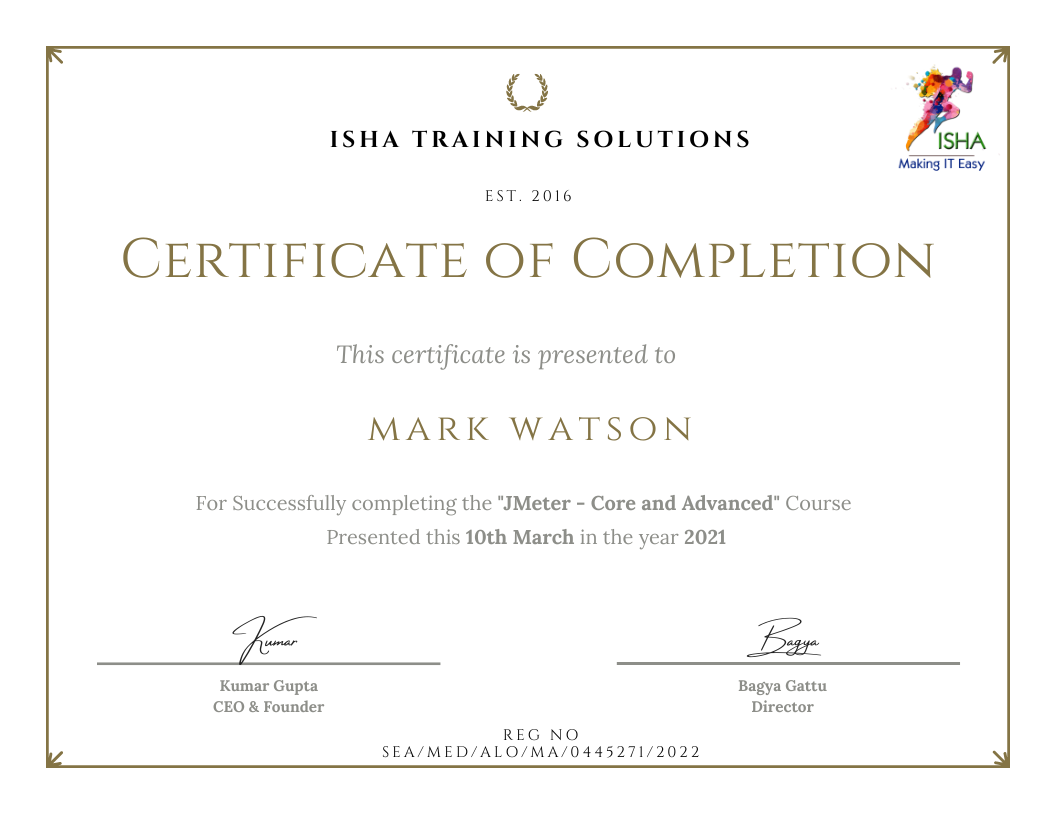
Sample Course Completion Certificate:
Your course completion certificate looks like this….
Course Policy :
Once payment is made, no refund will be provided.
If you do not attend the course, the payment cannot be transferred to another batch.
Course repetition is not allowed for missed sessions
We request all learners to attend the scheduled sessions regularly and make the most of their learning journey. Thank you for your understanding and continued support.
Course Features
- Lectures 89
- Quiz 0
- Duration 30 hours
- Skill level All levels
- Language English
- Students 530
- Assessments Yes
- 15 Sections
- 89 Lessons
- 30 Hours
- Module 1 — Onboarding & Prework (self-paced)2 Items
- Module 2 — Foundations of GenAI & Agentic AI for Testing3 Items
- Module 3 — Prompt Engineering & Guardrails for QA2 Items
- Module 4 — GenAI for Test Design & Test Data2 Items
- Module 5 — Auto-generate & Refactor Automation Code3 Items
- 5.1Use Copilot/GitHub Copilot/LLM code gen to create Selenium / Playwright / Cypress scripts; test reliability strategies
- 5.2Test maintenance: auto-refactor selectors, flaky test mitigation, test-to-selector mappings (MCP server / Playwright examples).
- 5.3Hands-on: generate Playwright tests for a demo app and run them locally; refactor a flaky test using LLM suggestions
- Module 6 — Building Agentic Testers3 Items
- 6.1Architectures for autonomous test agents: controllers, memory, tools, planning (LangChain / AutoGen / custom orchestrator)
- 6.2Agent capabilities: test discovery, test execution orchestration, triage & bug filing, self-healing attempts
- 6.3Hands-on: build a small agent (LangChain or OpenAI Agents / AutoGen style) that: reads a ticket → generates tests → executes them → files a report
- Module 7 — Production Integration & CI/CD3 Items
- 7.1Integrate agents into CI (GitHub Actions / Jenkins / GitLab) — scheduling, resource controls, cost management
- 7.2Observability, logging, human-in-the-loop approval flows, security considerations (secrets, PII)
- 7.3Hands-on: pipeline: commit → agent generates tests → run in headless cloud → post results to Slack/Jira
- Module 8 — Evaluation, Governance & Risk Mitigation3 Items
- Module 9 — MCP (Model Context Protocol) for Test Automation9 Items
- 9.1Introduction to Model Context Protocol (MCP)
- 9.2MCP Architecture: Host, Client and Server
- 9.3MCP Tools, Resources and Prompts
- 9.4Building Custom MCP Servers for Testing
- 9.5Playwright MCP Integration
- 9.6Browser Automation using MCP
- 9.7Connecting AI Agents with GitHub and Jira
- 9.8MCP-Based Test Execution Workflows
- 9.9Building an MCP-Powered QA Assistant
- Module 10 — Advanced Agentic AI Frameworks for QA10 Items
- 10.1Introduction to LangGraph
- 10.2Agent State Management and Workflow Design
- 10.3Sequential and Parallel Agent Workflows
- 10.4Conditional Routing and Decision Making
- 10.5Agent Memory and Context Management
- 10.6Tool Calling and Function Calling
- 10.7Planning and Execution Strategies
- 10.8Agent Collaboration and Communication
- 10.9Error Handling and Retry Mechanisms
- 10.10Building Stateful AI Testing Agents
- Module 11 — Autonomous Browser & UI Testing Agents10 Items
- 11.1Autonomous Browser Testing Architecture
- 11.2AI-Based Web Element Identification
- 11.3Intelligent Locator Generation
- 11.4Natural Language to Browser Actions
- 11.5AI-Based UI Test Execution
- 11.6Dynamic Element Handling
- 11.7Visual Regression Testing using AI
- 11.8Cross-Browser Testing Automation
- 11.9Self-Healing Locator Strategies
- 11.10Autonomous End-to-End Testing
- Module 12 — AI-Powered API & Microservices Testing9 Items
- 12.1AI-Based REST API Test Generation
- 12.2API Request and Response Validation
- 12.3Automated API Test Data Generation
- 12.4Schema and Contract Testing
- 12.5Authentication and Authorization Testing
- 12.6Negative API Testing
- 12.7Microservices Testing Strategies
- 12.8AI-Based API Failure Analysis
- 12.9API Automation using Playwright and Python
- Module 13 — Multi-Agent AI Testing Architecture11 Items
- 13.1Single-Agent vs Multi-Agent Systems
- 13.2Test Planner Agent
- 13.3Test Case Generator Agent
- 13.4Test Data Generator Agent
- 13.5UI Automation Agent
- 13.6API Testing Agent
- 13.7Test Execution Agent
- 13.8Bug Detection and Root Cause Analysis Agent
- 13.9Test Reporting Agent
- 13.10Multi-Agent Orchestration
- 13.11Building an End-to-End Autonomous QA System
- Module 14 — AI-Powered Test Intelligence & Optimization9 Items
- 14.1AI-Based Test Coverage Analysis
- 14.2Risk-Based Test Prioritization
- 14.3Intelligent Regression Test Selection
- 14.4AI-Based Defect Prediction
- 14.5Root Cause Analysis using LLMs
- 14.6Flaky Test Detection and Classification
- 14.7Automated Failure Pattern Analysis
- 14.8Test Execution Optimization
- 14.9AI-Based Quality Metrics and Reporting
- Module 15 — LLM Application Testing & AI Quality Engineering10 Items
- 15.1Testing AI Chatbots and Virtual Assistants
- 15.2LLM Functional and Non-Functional Testing
- 15.3Prompt Injection and Jailbreak Testing
- 15.4Hallucination Detection
- 15.5Response Accuracy and Relevance Evaluation
- 15.6RAG Application Testing
- 15.7LLM-as-a-Judge
- 15.8DeepEval Framework
- 15.9RAGAS Evaluation
- 15.10AI Model Reliability and Performance Testing