AI Product Management(AIPM) –Live Training
(Master AI Strategy, Product Discovery, Prototyping, Testing & Delivery)
This practical, industry-oriented course is designed for working professionals who want to build expertise in AI Product Management, including AI product discovery, strategy, requirements, prototyping, testing, delivery, and responsible AI decision-making.
The course combines Product Management practices with Artificial Intelligence, AI opportunity assessment, AI product requirements, AI interaction and workflow design, prototyping, quality evaluation, risk controls, stakeholder management, and product strategy.
Participants will learn how to identify AI opportunities, evaluate AI and non-AI approaches, define AI product requirements, collaborate with technical and business teams, test AI products, manage risks, plan launches, measure product outcomes, and defend AI product recommendations through a practical capstone project.
About the Instructor:
| Ananth is an experienced technology professional, AI trainer, and product-focused mentor with a passion for helping software engineers, technology professionals, and aspiring AI leaders accelerate their careers. With 15+ years of overall industry experience and 4 years of teaching experience, he has successfully trained 250+ students, helping them build practical technical skills and develop the confidence to succeed in today’s evolving technology landscape.
He brings diverse experience across Deep Tech, SaaS, Enterprise, Startups, Telecom, Legal Compliance, AML & Fraud, and EdTech. His expertise spans AI and emerging technologies, product thinking, problem-solving, leadership, strategic communication, people management, and career development. He combines technical understanding with a strong focus on business value, customer needs, and practical product strategy. Currently, Ananth teaches Claude AI Solution Architect and AI Product Management concepts, helping learners understand modern AI technologies, AI-powered products, product strategy, and real-world applications. His industry experience and engaging teaching approach make learning practical, career-focused, and relevant for both technical and product professionals. |
Live Sessions Price:
For LIVE sessions – Offer price after discount is 149 USD 129 109 USD Or USD12000 INR10900 INR 8900 Rupees
Free Demo On:
Indian Timings: 22nd October @ 9 PM – 10 PM (IST)/
U.S Timings: 22nd October @ 11:30 AM – 12:30 PM (EST)/
U.K Timings: 22nd October @ 4:30 PM – 5:30 PM (BST)
Class Schedule:
For Participants in India: Monday to Friday @ 9 PM – 10 PM (IST)
For Participants in the US: Monday to Friday @ 11:30 AM – 12:30 PM (EST)
For Participants in the UK: Monday to Friday @ 4:30 PM – 5:30 PM (BST)
Course syllabus:
MODULE 01: Discover and Frame the Right AI Problem
✦ Understanding the AI Product Manager role
✦ Product ownership vs AI engineering responsibilities
✦ Identifying AI-suitable business opportunities
✦ Customer and workflow discovery
✦ Conducting customer interviews and identifying pain points
✦ Mapping existing workflows before proposing AI solutions
✦ Understanding market and business context
✦ Connecting AI opportunities with business strategy
✦ AI vs Non-AI solution evaluation
✦ Evaluating value, feasibility, cost, uncertainty, and trust
✦ Identifying assumptions and validating them with evidence
✦ Presenting an AI opportunity to stakeholders
✦ Making Continue, Pivot, or Stop decisions
✦ Creating a Discovery Brief and Opportunity Decision Memo
✦ Building a Stakeholder Map
MODULE 02: Align Stakeholders and Define the AI Product
✦ Identifying key AI product stakeholders
✦ Working with Users, Buyers, Engineering, Data, Design, QA, Operations, Legal, Security, Risk, and GTM teams
✦ Developing AI product strategy and product narrative
✦ Defining product promise and desired business outcomes
✦ Understanding strategic fit and business priorities
✦ Defining AI product requirements
✦ Understanding inputs, outputs, context, and constraints
✦ Designing fallback and human-oversight mechanisms
✦ Defining AI product acceptance criteria
✦ Prioritizing AI use cases
✦ Defining and scoping the AI MVP
✦ Evaluating value, evidence, effort, uncertainty, and risk
✦ Conducting stakeholder alignment workshops
✦ Resolving competing stakeholder requirements
✦ Defining decision rights and documenting product decisions
✦ Creating an AI Product Brief / PRD
✦ Creating a Prioritized MVP and Decision Log
MODULE 03: Prototype, Test and Evaluate AI Products
✦ Understanding AI prototype strategies
✦ Storyboard-based prototyping
✦ Wizard-of-Oz prototyping
✦ No-code AI prototyping
✦ API-assisted AI prototypes
✦ Selecting the right prototype based on product uncertainty
✦ Designing AI interactions and workflows
✦ Context management and structured outputs
✦ User control and human handoffs
✦ Designing fallback behaviour
✦ Understanding AI technical trade-offs
✦ Working with Engineering and Data teams
✦ Model and data considerations
✦ Retrieval, latency, cost, and vendor dependency
✦ Build vs Buy decisions
✦ Defining AI quality criteria and release thresholds
✦ Defining task success and acceptable error levels
✦ Designing AI test sets
✦ Normal, edge, adversarial, and role-specific test cases
✦ Analysing AI failures and identifying root patterns
✦ Testing privacy, bias, security, misuse, and transparency
✦ Designing human-oversight controls
✦ Making Improve, Narrow, Pilot, Monitor, or Stop decisions
✦ Creating an AI Test Set and Quality Scorecard
MODULE 04: Lead AI Product Delivery, Adoption and Measurement
✦ Building an AI product roadmap under uncertainty
✦ Sequencing experiments and learning milestones
✦ Managing dependencies and product risks
✦ Cross-functional AI product leadership
✦ Defining decision rights and working agreements
✦ Managing conflicts and escalations
✦ Communicating with executive stakeholders
✦ AI product launch planning
✦ Change management and user adoption
✦ User onboarding and enablement
✦ Managing affected business workflows
✦ Creating feedback loops after launch
✦ AI release-readiness assessment
✦ Working with QA, Engineering, Legal, Operations, and Business teams
✦ Defining fallback and escalation processes
✦ AI product metrics and review cadence
✦ Measuring adoption and task success
✦ Monitoring errors, incidents, cost, and business outcomes
✦ Defining pause and rollback triggers
✦ Creating an AI Product Roadmap
✦ Creating RACI and Decision Logs
✦ Creating a Launch Checklist and Monitoring Plan
MODULE 05: Integrate and Defend the AI Product Recommendation
✦ Connecting customer evidence with product strategy
✦ Connecting product scope with AI test results
✦ Reviewing risk controls and launch readiness
✦ Evaluating the complete AI product evidence chain
✦ Stakeholder simulation and decision-making
✦ Handling Engineering, Risk, Sales, Finance, and Executive challenges
✦ Presenting AI product recommendations to leadership
✦ Communicating decisions, evidence, trade-offs, and residual risks
✦ Identifying evidence gaps and next learning milestones
✦ Preparing the final AI PM portfolio
✦ Conducting an AI Product Decision Review
✦ Defending the AI product recommendation
✦ Presenting a final AI PM capstone project
✦ Preparing a 10-minute AI Product Decision Defence
Frequently Asked Questions (FAQ’S):
1. What is AI Product Management?
AI Product Management focuses on building and managing AI-driven products.
2. Who can join this course?
Product Owners, Project Managers, Scrum Masters, QE Managers, Developers, Engineers, and aspiring PMs.
3. Do I need an AI background?
A deep AI engineering background is not required.
4. What will I learn in this course?
AI product discovery, requirements, prototyping, testing, delivery, and measurement.
5. Will I learn AI product testing?
Yes, the course covers AI testing, quality criteria, test sets, and failure analysis.
6. Will I learn AI product strategy?
Yes, you will learn product strategy, prioritization, MVP definition, and stakeholder alignment.
7. Is there a practical project?
Yes, the programme includes an AI PM evidence pack and final decision-defence exercise.
8. What roles is this course suitable for?
It is suitable for professionals moving toward AI Product Management roles.
9. Will I learn to work with technical teams?
Yes, you will work with Engineering, Data, Design, QA, Security, and Business teams.
10. What is the main outcome of the course?
You will learn to evaluate, define, test, and defend an AI product recommendation.
OR
For any other details, Call me or Whatsapp me on +91-9133190573
Live Sessions Price:
For LIVE sessions – Offer price after discount is 149 USD 129 109 USD Or USD12000 INR10900 INR 8900 Rupees
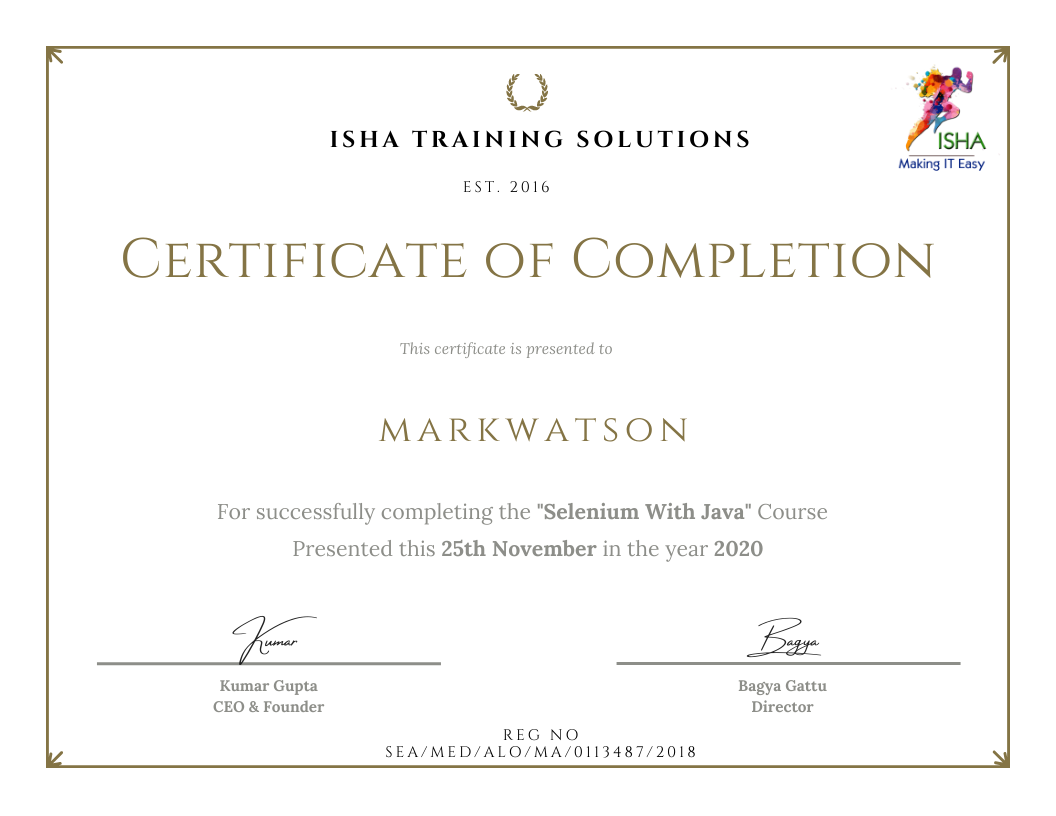
Sample Course Completion Certificate:
Your course completion certificate looks like this……
 Note:
Note:
To maintain the quality of our training and ensure a smooth learning experience for all participants, we do not allow batch repetition or switching between courses.
To reiterate, moving from one course to another or shifting from one trainer to another (even if it is the same course) is not possible. Changing batches or trainers in any form is strictly not permitted.
We request all learners to attend the scheduled sessions regularly and make the most of their learning journey. Thank you for your understanding and continued support.
Course Features
- Lectures 224
- Quiz 0
- Duration 30 hours
- Skill level All levels
- Language English
- Students 0
- Assessments Yes
- 13 Sections
- 224 Lessons
- 30 Hours
- MODULE 01: Introduction to AI Product ManagementUnderstanding the AI Product Manager Role13
- 1.1What is an AI Product Manager?
- 1.2AI Product Manager vs Traditional Product Manager
- 1.3AI Product Manager vs AI Project Manager
- 1.4AI Product Manager vs AI Program Manager
- 1.5AI Product Manager vs Product Owner
- 1.6AI Product Manager vs Business Analyst
- 1.7AI Product Manager vs AI Solutions Architect
- 1.8How AI is changing software products and IT services
- 1.9Why traditional IT professionals are moving into AI roles
- 1.10Career pathways for Project Managers, BAs, Developers, QA Leads, and Technical Leads
- 1.11Skills required to become an AI Product Manager
- 1.12What AI Product Managers do in their daily work
- 1.13Working with Product, Engineering, Data Science, UX, QA, Security, and Business teams
- MODULE 02: Artificial Intelligence & Machine Learning FundamentalsLearn AI Without Becoming a Data Scientist15
- 2.1What is Artificial Intelligence?
- 2.2AI vs Machine Learning vs Deep Learning
- 2.3Supervised Learning
- 2.4Unsupervised Learning
- 2.5Reinforcement Learning
- 2.6Classification and Regression
- 2.7Natural Language Processing
- 2.8Computer Vision
- 2.9Recommendation Systems
- 2.10Predictive Analytics
- 2.11Training vs Inference
- 2.12Datasets, Features, Labels, and Models
- 2.13Model Accuracy and Limitations
- 2.14Common AI use cases across industries
- 2.15Understanding AI terminology used by technical teams
- MODULE 03: Generative AI, LLMs & Foundation ModelsUnderstanding the Technology Behind Modern AI Products17
- 3.1What is Generative AI?
- 3.2What are Large Language Models?
- 3.3Foundation Models
- 3.4Tokens and Context Windows
- 3.5Prompting and Model Instructions
- 3.6System Prompts and User Prompts
- 3.7Temperature and Model Behaviour
- 3.8Model Selection
- 3.9Open-Source vs Commercial Models
- 3.10Cloud AI vs Local AI
- 3.11APIs and AI Application Integration
- 3.12Multimodal AI
- 3.13Text, Image, Audio, and Video AI
- 3.14AI Assistants and Copilots
- 3.15Understanding Model Limitations
- 3.16Hallucinations and Inaccurate Responses
- 3.17AI Product Opportunities in Enterprise IT
- MODULE 04: AI Product Discovery & Business Opportunity IdentificationFrom Business Problems to AI Product Opportunities18
- 4.1Understanding customer problems
- 4.2Identifying AI opportunities
- 4.3AI use-case discovery
- 4.4Customer interviews and stakeholder discussions
- 4.5Problem Statements
- 4.6User Personas
- 4.7Customer Journey Mapping
- 4.8Jobs-to-be-Done
- 4.9AI Opportunity Mapping
- 4.10Identifying repetitive and knowledge-intensive processes
- 4.11Identifying opportunities for automation
- 4.12Identifying opportunities for prediction and decision support
- 4.13Identifying opportunities for Generative AI
- 4.14Identifying opportunities for AI Agents
- 4.15Build vs Buy vs Integrate
- 4.16Evaluating AI feasibility
- 4.17Business value vs technical complexity
- 4.18AI opportunity prioritization
- MODULE 05: AI Product Strategy, Roadmaps & Business CasesTurning AI Ideas into a Product Strategy20
- 5.1Product Discovery vs Product Delivery
- 5.2AI Product Roadmaps
- 5.3ROI and Cost-Benefit Analysis
- 5.4Defining AI Product Value
- 5.5Business Case Development
- 5.6Product Goals and Objectives
- 5.7Product Strategy
- 5.8AI Product Vision
- 5.9MVP Planning
- 5.10AI MVP vs Traditional MVP
- 5.11Prioritization Frameworks
- 5.12RICE
- 5.13MoSCoW
- 5.14Value vs Effort
- 5.15Build vs Buy Decisions
- 5.16Vendor Evaluation
- 5.17AI Product Risks
- 5.18Stakeholder Alignment
- 5.19Executive Communication
- 5.20AI Product Investment Decisions
- MODULE 06: AI Product Requirements, UX & User ExperienceDesigning Products That Use AI Effectively18
- 6.1Writing AI Product Requirements
- 6.2Product Requirement Documents (PRDs)
- 6.3User Stories for AI Features
- 6.4Acceptance Criteria
- 6.5Functional vs Non-Functional Requirements
- 6.6AI-Specific Requirements
- 6.7Defining Expected Model Behaviour
- 6.8AI User Experience Design
- 6.9Human-in-the-Loop Workflows
- 6.10User Feedback Mechanisms
- 6.11Explainability and Transparency
- 6.12Handling Uncertain AI Responses
- 6.13Accessibility and Inclusive AI Product Design
- 6.14Designing AI Assistants and Copilots
- 6.15Designing Trustworthy AI Experie
- 6.16AI Error Messages and Recovery
- 6.17User Confirmation and Approval Flows
- 6.18Designing AI Search and Knowledge Systems
- MODULE 07: AI Product Development LifecycleManaging AI Products from Idea to Production20
- 7.1AI Product Development Lifecycle
- 7.2AI Product Discovery
- 7.3Data Readiness Assessment
- 7.4Data Collection and Preparation
- 7.5Data Quality
- 7.6Data Annotation and Labelling
- 7.7Model Selection
- 7.8Model Development
- 7.9Model Evaluation
- 7.10AI Application Development
- 7.11Integration with Existing Systems
- 7.12Testing AI Features
- 7.13User Acceptance Testing
- 7.14AI Product Release Planning
- 7.15Deployment and Production Readiness
- 7.16Monitoring AI Products
- 7.17Feedback Loops
- 7.18Continuous Improvement
- 7.19Managing AI Product Changes
- 7.20Working with Agile AI Teams
- MODULE 08: Generative AI Applications, RAG & AI AgentsUnderstanding Modern AI Product Architecture18
- 8.1Writing AI Product Requirements
- 8.2Product Requirement Documents (PRDs)
- 8.3User Stories for AI Features
- 8.4Acceptance Criteria
- 8.5Functional vs Non-Functional Requirements
- 8.6AI-Specific Requirements
- 8.7Defining Expected Model Behaviour
- 8.8AI User Experience Design
- 8.9Human-in-the-Loop Workflows
- 8.10User Feedback Mechanisms
- 8.11Explainability and Transparency
- 8.12Handling Uncertain AI Responses
- 8.13Designing Trustworthy AI Experiences
- 8.14AI Error Messages and Recovery
- 8.15User Confirmation and Approval Flows
- 8.16Designing AI Assistants and Copilots
- 8.17Designing AI Search and Knowledge Systems
- 8.18Accessibility and Inclusive AI Product Design
- MODULE 09: AI Evaluation, Quality, Cost & PerformanceThe Most Important AI-Specific Product Management Skills24
- 9.1Why AI Products Are Different
- 9.2AI Quality vs Traditional Software Quality
- 9.3Model Evaluation
- 9.4Evaluation Datasets
- 9.5Test Cases for AI Applications
- 9.6Accuracy and Relevance
- 9.7Hallucination Testing
- 9.8Response Quality
- 9.9Groundedness
- 9.10Safety Evaluation
- 9.11Bias and Fairness
- 9.12AI Output Consistency
- 9.13Human Evaluation
- 9.14Automated Evaluation
- 9.15A/B Testing for AI Features
- 9.16AI Product Metrics
- 9.17Cost per AI Request
- 9.18Token Usage
- 9.19Latency and Response Time
- 9.20Model Quality vs Cost Trade-offs
- 9.21Model Quality vs Speed Trade-offs
- 9.22Production Monitoring
- 9.23AI Feedback Loops
- 9.24Defining AI Product Success Metrics
- MODULE 10: Responsible AI, Security & AI Product GovernanceBuilding Safe and Responsible AI Products21
- 10.1Responsible AI Fundamentals
- 10.2AI Ethics
- 10.3Bias and Fairness
- 10.4Privacy and Data Protection
- 10.5Sensitive Data Handling
- 10.6AI Security Risks
- 10.7Prompt Injection
- 10.8Data Leakage
- 10.9AI Misuse
- 10.10Model Limitations
- 10.11Working with Security, Legal, and Compliance Teams
- 10.12AI Product Governance
- 10.13AI Incident Management
- 10.14Responsible AI Product Requirements
- 10.15Enterprise AI Policies
- 10.16AI Compliance Considerations
- 10.17AI Risk Assessment
- 10.18AI Governance
- 10.19Transparency
- 10.20Human Oversight
- 10.21Explainability
- MODULE 11: AI Project & Program ManagementFor Project Managers and Delivery Professionals20
- 11.1AI Project vs Traditional IT Project
- 11.2AI Project Scope
- 11.3AI Project Dependencies
- 11.4AI Project Risks
- 11.5AI Project Planning
- 11.6AI Project Estimation
- 11.7AI Project Management Fundamentals
- 11.8AI Project Production Readiness
- 11.9AI Project Release Planning
- 11.10Managing AI Project Uncertainty
- 11.11AI Project Communication
- 11.12AI Project Change Management
- 11.13AI Project Delivery Metrics
- 11.14AI Project Milestones
- 11.15AI Project Status Reporting
- 11.16AI Project Governance
- 11.17Working with AI Engineers Working with Product Managers
- 11.18Working with Data Scientists and ML Engineers
- 11.19AI Project Stakeholder Management
- 11.20AI Project Team Structure
- MODULE 12: AI Product Manager Tools & Practical WorkflowsUsing AI Tools to Become a More Effective Product Manager0
- Using AI Tools to Become a More Effective Product Manager20
- 13.1Using ChatGPT for Product Discovery
- 13.2Using Claude for Product Documentation
- 13.3Using AI for Market Research
- 13.4Using AI for Market Research
- 13.5Using AI for PRD Creation
- 13.6Using AI for User Stories
- 13.7Using AI for Acceptance Criteria
- 13.8Using AI for Product Roadmaps
- 13.9Using AI for Competitive Analysis
- 13.10Using AI for Business Cases
- 13.11AI-Assisted Product Management
- 13.12Building Reusable AI Workflows
- 13.13Prompt Engineering for Product Managers
- 13.14Using AI for Product Decision Support
- 13.15Using AI for Product Planning
- 13.16Using AI for Product Documentation
- 13.17Using AI for Risk Analysis
- 13.18Using AI for Stakeholder Communication
- 13.19Using AI for Meeting Summaries
- 13.20Using AI for Product Metrics


