Forward Deployment Engineer (FDE) – Live Training
(FDE Mindset, AI & LLMs, Prompt Engineering, RAG, AI Agents, Multi-Agent Systems, MCP, System Design, APIs, Scalability, Docker, CI/CD, Cloud Deployment, AI Security, Observability & Production Engineering)
This course is designed to build practical expertise in AI, Generative AI, LLMs, RAG, AI Agents, Multi-Agent Systems, and Model Context Protocol (MCP) while developing the system-design and engineering skills required for modern enterprise applications. The course covers LLM fundamentals, prompt engineering, structured outputs, RAG architectures, embeddings, vector databases, agent architectures, multi-agent workflows, MCP integrations, AI safety, guardrails, and responsible AI deployment.
The course also focuses on the engineering side of production AI through System Design, APIs, databases, scalability, reliability, Docker, CI/CD, cloud deployment, Infrastructure as Code, and Observability. Learners will understand how to design scalable AI systems, deploy applications using modern DevOps practices, and monitor LLM, RAG, Agent, and MCP workloads using logs, metrics, traces, Prometheus, Grafana, CloudWatch, ELK Stack, and AI observability platforms.
About the Instructor:
| Karthick is an experienced Forward-Deployed Engineer (FDE), AI Engineer, and Trainer with 10+ years of overall industry experience, including 6+ years of experience in Java development and 5 years of experience in FDE and AI technologies. He brings strong experience in software engineering, backend development, enterprise applications, system design, cloud technologies, Generative AI, LLMs, RAG, AI Agents, Multi-Agent Systems, and Model Context Protocol (MCP). His professional background includes experience with enterprise technology and modern engineering practices, including work associated with Cisco.
Karthick has trained 200+ IT professionals and focuses on helping learners connect software engineering fundamentals with modern AI and Forward-Deployed Engineering practices. His expertise aligns closely with the course areas including AI and LLM fundamentals, RAG, AI Agents, MCP, APIs, system design, scalability, Docker, CI/CD, cloud deployment, AI security, and observability. His professional activity also reflects practical interest in areas such as Kubernetes, cloud-native engineering, DevOps, AI automation, and production-oriented software engineering.
As a trainer, Karthick emphasizes clear explanations, practical examples, engineering problem-solving, and real-world application scenarios. His teaching approach brings together FDE practices, AI engineering, system architecture, DevOps, cloud deployment, and production observability, helping professionals understand how modern AI applications are designed, deployed, integrated, and monitored in enterprise environments. |
Live Sessions Price:
For LIVE sessions – Offer price after discount is 200 USD 159 USD 119 USD Or 15000 INR13000 INR 9900 Rupees
Enroll for a Free Demo
OR
WhatsApp
Free Demo On:
Indian Timings: 22nd October @ 9 PM – 10 PM (IST)/
U.S Timings: 22nd October @ 11:30 AM – 12:30 PM (EDT)/
U.K. Timings: 22nd October @ 4:30 PM – 5:30 PM (BST)
Class Schedule:
For Participants in India: Monday, Wednesday, Thursday and Friday @ 9 PM – 10 PM (IST)/
For Participants in the US: Monday, Wednesday, Thursday and Friday @ 11:30 AM – 12:30 PM (EST)/
For Participants in the UK: Monday, Wednesday, Thursday and Friday @ 4:30 PM – 5:30 PM (BST)
Note for US & UK students: Daylight Saving Time ends on 25th Oct (UK) and 1st Nov 2026 (US). UK classes run at 3:30 – 4:30 PM (GMT); from 1st Nov, US classes run at 10:30 – 11:30 AM (EST). India stays the same (9 – 10 PM IST).
Payment Options
Pay securely via QR scan or direct bank transfer.
Once your payment is completed, please send your payment screenshot, full name, and WhatsApp number to +91 9063292427 via WhatsApp to confirm your enrollment.
Pay via Google Pay or PhonePe using: +91 9133190573 (For Indian accounts only)
Pay via Razorpay (For Indian accounts only)

🌎 Pay via PayPal (For international accounts only)
Students based in the USA and other international locations can pay securely via PayPal using the button below.
Pay via Razorpay (For international accounts only)
What Our Students Say About the Trainer:
|
The sessions were clear, practical, and easy to follow. I really liked the way complex concepts were explained with simple examples. – Ananya
I found the training very useful, especially the AI and system design topics. The practical approach made it easier to understand how these concepts fit together in real projects.- Elizabeth
The trainer has a very structured way of teaching. Each topic was explained step by step, and the sessions gave me a better understanding of AI applications, system design, and deployment. – Neha
I really enjoyed the training because it was not just focused on theory. The trainer explained each concept with practical and real-time examples, which made the sessions much easier to follow. I especially liked how the topics were connected to real-world project scenarios. The trainer also took time to clarify questions and explain difficult concepts in a simple way. Overall, it was a very useful and engaging learning experience.” — James
This was a very informative training program. I particularly liked the sessions on RAG, AI Agents, MCP, and system design. The explanations were clear, and my doubts were addressed patiently. – Meera
The training helped me understand several concepts that I previously found difficult. The trainer explained everything in a simple and practical manner, with relevant examples from real projects. I especially appreciated the focus on AI applications, system design, deployment, and observability. Overall, it was a valuable learning experience and helped improve my technical confidence. – Rohit
|
Who can enroll for this course:
- Forward-Deployed Engineers (FDEs/FTEs) looking to strengthen their AI, system design, deployment, and production engineering skills.
- Software Engineers and Developers who want to work with LLMs, RAG, AI Agents, Multi-Agent Systems, and MCP.
- AI/ML Engineers and Generative AI Engineers interested in building and deploying production-ready AI applications.
- Solution Architects and Technical Architects who want to understand AI system architecture, APIs, scalability, reliability, and enterprise integrations.
- DevOps, Cloud, and Platform Engineers who want to deploy and manage AI applications using Docker, CI/CD, cloud infrastructure, and observability tools.
- Backend/API Engineers working with REST APIs, microservices, databases, message queues, and distributed systems.
- Engineers and IT professionals who want to build expertise across AI, system design, DevOps, and AI observability for modern enterprise applications.
Salient Features:
- 30+ Hours of Live Training along with recorded videos
- 1 Year Access to Session Recordings
- Course Completion Certificate
What will I learn by the end of this course?
- Understand the Forward-Deployed Engineer (FDE) role, critical thinking, engineering decision-making, and the application of AI in enterprise environments.
- Build a strong foundation in AI, Generative AI, LLMs, prompt engineering, structured outputs, RAG, AI Agents, Multi-Agent Systems, and MCP.
- Design AI-powered applications using RAG architectures, embeddings, vector databases, retrieval strategies, agent workflows, tools, memory, and MCP integrations.
- Apply system design principles to build scalable and reliable applications using APIs, microservices, databases, caching, message queues, load balancing, fault tolerance, and event-driven architectures.
- Understand and design AI application architectures for inference services, RAG systems, agent systems, MCP servers, and event-driven AI pipelines.
- Containerize and deploy applications using Docker, Docker Compose, GitHub Actions, CI/CD pipelines, cloud services, deployment strategies, and Infrastructure as Code concepts.
- Implement observability using structured logging, metrics, traces, Prometheus, Grafana, CloudWatch, and ELK Stack.
- Monitor and analyze AI applications using LLM, RAG, Agent, and MCP observability, including latency, token usage, cost, retrieval performance, tool calls, errors, and evaluation metrics.
- Understand AI safety and responsible deployment, including hallucinations, bias, data privacy, PII handling, guardrails, content filtering, and human-in-the-loop practices.
Course Syllabus:
Section A — AI Concepts:
Module A1 — The FTE Role and AI in the Enterprise
- What is a Forward-Deployed Engineer (FTE)?
- FTE vs. SWE vs. SA — role boundaries
- Where AI fits in the FTE toolkit
- Course roadmap and learning objectives
Module A2 — Critical Thinking for FDEs
- Separating symptoms from root cause — 5 Whys, Fishbone diagram
- Managing assumptions — recognize and validate before coding
- Asking the right questions — discovery questioning technique
- Trade-off reasoning — reversible vs. irreversible decisions
- Cognitive biases in engineering decisions
- Prioritization under pressure — Eisenhower Matrix
Module A3 — AI and LLM Fundamentals
- What is AI — practical definition
- ML vs. Deep Learning vs. Generative AI
- What is a Large Language Model (LLM)?
- How LLMs are trained — pre-training, fine-tuning, RLHF
- Tokens, context windows, and temperature
- Key LLM providers and models
- Prompt engineering — zero-shot, few-shot, chain-of-thought
- Structured output — JSON mode, function calling
Module A4 — Retrieval-Augmented Generation (RAG)
- RAG architecture and end-to-end workflow
- Embeddings, vector databases, and similarity search
- Document ingestion and chunking strategies
- Retrieval, context construction, and generation
- RAG challenges, improvements, and evaluation
Module A5 — AI Agents
- What is an AI agent — LLM + tools + memory + planning
- Agents vs. chatbots vs. pipelines
- Agent architecture — perception, planning, action, memory
- The ReAct loop — Reason, Act, Observe, Repeat
- Agent frameworks — LangChain, CrewAI, Autogen
- Common agent failures and mitigation
Module A6 — Multi-Agent Systems
- Why multi-agent — when a single agent isn’t enough
- Multi-agent architectures — supervisor, peer-to-peer, pipeline, hierarchical
- Task decomposition and agent specialization
- Inter-agent communication — shared memory, message passing
- Challenges — coordination, conflicts, cost, debugging
Module A7 — Model Context Protocol (MCP) & Integrations
- What is MCP and why it matters for enterprise integration
- MCP architecture — hosts, clients, servers
- MCP primitives — resources, tools, prompts, sampling
- Transport layers — stdio vs. Streamable HTTP
- MCP vs. function calling vs. REST APIs
- Building and invoking an MCP server
- Real-world MCP integrations — filesystem, Git, Slack, databases
- AI workflow and automation patterns
Module A8 — AI Ethics, Safety, and Responsible Deployment
- Hallucinations and factual accuracy
- Bias in LLMs and mitigation
- Data privacy and PII handling
- Guardrails and content filtering
- Human-in-the-loop for production AI
Section B — System Design :
Module B1 — System Design Fundamentals
- Client-server architecture
- Monolith vs. microservices
- Stateless vs. stateful services
- Synchronous vs. asynchronous communication
- Design principles — SoC, SRP, DRY, KISS
Module B2 — APIs and Communication Patterns
- REST API design — resources, methods, status codes, auth
- Message queues and pub/sub — SQS, Kafka, RabbitMQ
- gRPC and protocol buffers
- WebSockets and real-time communication
- API gateway pattern
Module B3 — Data Storage and Databases
- Relational databases — PostgreSQL, indexing, ACID
- NoSQL databases — MongoDB, DynamoDB, Redis
- Object storage — S3
- Caching strategies — Redis, cache-aside, TTL
- Data modeling — normalization vs. denormalization
Module B4 — Scalability and Reliability
- Horizontal vs. vertical scaling
- Load balancing strategies
- Fault tolerance — retries, circuit breakers, bulkhead, timeouts
- Rate limiting and throttling
- CAP theorem and eventual consistency
Module B5 — System Design for AI Applications
- AI inference service design — batch vs. real-time
- RAG system architecture at scale
- Agent system architecture — tool registry, sessions, cost controls
- MCP servers as microservices
- Event-driven AI pipelines
- Cost optimization — model selection, caching, token budgets
Section C — Devops & Ci/Cd :
Module C1 — Containers and Docker
- Containers vs. virtual machines
- Docker fundamentals — images, containers, layers, registries
- Writing a Dockerfile — FROM, RUN, COPY, CMD, multi-stage builds
- Docker Compose — multi-container local development
- Packaging a Python application
Module C2 — CI/CD Fundamentals
- CI vs. CD vs. CD (integration, delivery, deployment)
- Pipeline anatomy — source, build, test, package, deploy
- GitHub Actions — workflows, jobs, steps, triggers, secrets
- Branch strategies — trunk-based, feature branches
- Environment promotion — dev, staging, production
Module C3 — Deployment and Infrastructure
- Deployment strategies — rolling, blue-green, canary, feature flags
- Cloud deployment — ECS/Fargate, Lambda, EC2, S3
- Infrastructure as Code — Terraform / CloudFormation overview
- Environment management — secrets managers, config management
- Deploying AI applications — MCP servers, RAG pipelines, agents
Section D — Observability :
Module D1 — Observability Fundamentals
- Observability vs. monitoring
- The three pillars — logs, metrics, traces
- Observability culture for FTEs
Module D2 — Logging
- Structured logging — JSON, log levels, correlation IDs
- Python logging — stdlib, structlog
- Log aggregation — CloudWatch, ELK Stack
- Logging best practices — what to log, what not to log
Module D3 — Metrics and Dashboards
- Metric types — counters, gauges, histograms
- RED and USE metrics
- Prometheus + Grafana
- Alerting — symptoms vs. causes, alert fatigue
Module D4 — Observability for AI Systems
- LLM observability — tokens, latency, cost, errors
- RAG pipeline observability — retrieval metrics, quality scores
- Agent observability — tool calls, loop counts, cost per task
- MCP server observability — invocation latency, session health
- LLM observability platforms — LangSmith, Langfuse, Arize Phoenix
- Evaluation drift detection and A/B testing
FAQ’s for Forward Deployed Engineer (FDE) Salesforce Course:
How can I enroll for this course?
Enroll For Free Demo
OR
For any other details, Call me or Whatsapp me on +91-9133190573
Live Sessions Price:
For LIVE sessions – Offer price after discount is 200 USD 159 USD 119 USD Or 15000 INR 13000 INR 9900 Rupees.
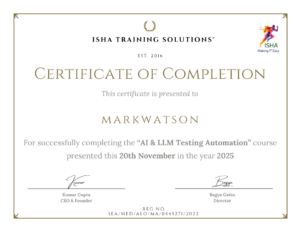
Sample Course Completion Certificate:
Your course completion certificate looks like this……
Course Policy :
Once payment is made, no refund will be provided.
If you do not attend the course, the payment cannot be transferred to another batch.
Course repetition is not allowed for missed sessions
We request all learners to attend the scheduled sessions regularly and make the most of their learning journey. Thank you for your understanding and continued support.