
ETL Testing Automation with Cloud & AI – Live Training
(Learn SQL, SSIS, Azure Data Factory, Databricks, Python, PySpark, PyTest & Power BI)
This comprehensive ETL Testing Automation course is designed to help learners master modern ETL, Data Testing, and Big Data validation concepts using SQL, SSIS, Azure Data Factory, Python, PySpark, Pytest, Databricks, and Power BI. The training covers end-to-end ETL testing including source-to-target validation, data reconciliation, transformation testing, row count validation, schema and data type validation, duplicate and NULL validation, incremental load testing, business-rule validation, data-quality checks, and Power BI data validation. Learners will gain practical experience with Azure Data Lake, ADF pipelines, Databricks, PySpark DataFrames, Delta tables, SQL validation queries, and reusable Python validation functions.
The course is highly practical and industry-focused, with dedicated coverage of ETL automation framework development using Python, PySpark, and Pytest. Participants will learn to create reusable validation functions, automate ETL test cases, execute complete test suites, implement logging and reporting, capture failed records, and analyze validation results. The training also includes an end-to-end ETL testing project covering SSIS, Azure Data Factory, Azure Data Lake, Databricks, PySpark, SQL, Python, Pytest, and Power BI. This course is ideal for Manual Testers, ETL Testers, Automation Engineers, Data QA Professionals, Big Data Testers, Data Engineers, and freshers looking to build careers in ETL Testing, Data Testing, Big Data Testing, or Data QA Automation.
About the Instructor:
|
Haran is a passionate and highly experienced Data Professional with over 13 years of expertise in ETL Testing, ETL Automation Testing, Cloud Data Integration, and Azure Data Engineering. Throughout his career, he has successfully designed, implemented, automated, and validated complex enterprise data pipelines and cloud migration solutions using leading technologies such as Azure Data Factory (ADF), Azure Synapse Analytics, Azure Data Lake, SQL, PySpark, Power BI, and modern ETL Automation Frameworks. He possesses strong hands-on experience in SQL-driven ETL Transformations, Automated Data Validation Frameworks, Real-Time Data Quality Monitoring, Reconciliation Testing, and End-to-End ETL Automation using PySpark & Pytest. Haran is highly passionate about teaching and strongly believes in practical, real-time, and project-oriented learning methodologies. His training sessions are highly interactive, industry-focused, and designed around real-world project scenarios, helping learners gain project-ready skills and confidence to work in modern Cloud and Big Data environments. Known for his clear explanation style and learner-friendly approach, Haran has successfully trained and mentored 300+ students and working professionals in ETL Testing, Data Engineering, Azure Analytics, and ETL Automation Technologies. His dedication towards mentoring and knowledge sharing has helped many professionals successfully transition into high-demand Cloud Data Engineering and ETL Automation roles. |
Sample Videos
ETL Testing Automation with Cloud & AI – Live Training Demo
ETL Testing Automation with Cloud & AI – Live Training day1
Live Sessions Price:
Live Sessions Price:
For LIVE sessions – Offer price after discount is 300 USD 259 89 USD Or USD13000 INR 12900 INR 6900 Rupees
OR
Free Demo On:
21st September @ 9:00 PM – 10:00 PM (IST) (Indian Timings)/
21st September @ 11:30 AM –12:30 PM (EST) (U.S Timings)/
21st September @ 4:30 PM – 5:30 PM (BST) (U.K Timings)
Class Schedule:
For Participants in India: Monday to Friday @ 9:00 PM – 10:00 PM (IST)
For Participants in the US: Monday to Friday @ 11:30 AM –12:30 PM (EST)
For Participants in the UK: Monday to Friday @ 4:30 PM – 5:30 PM (BST)
What students have to say about Haran:
|
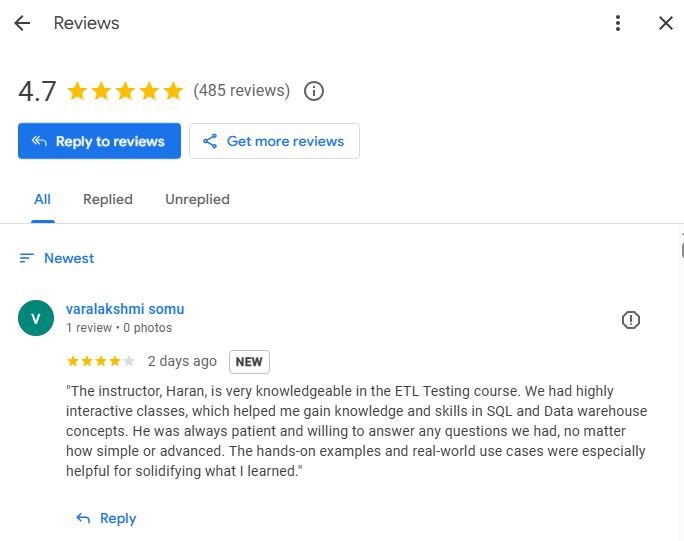
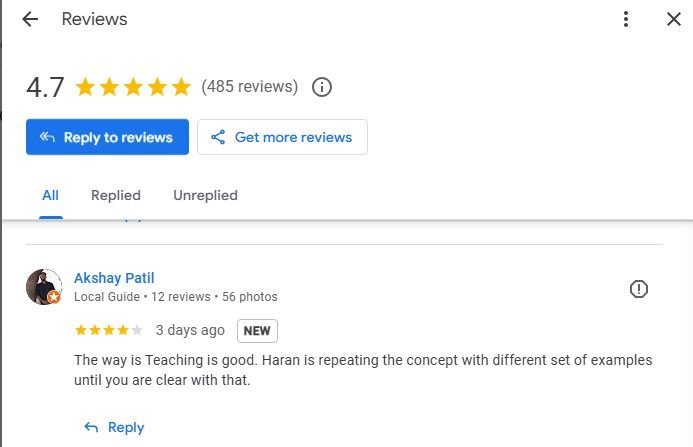
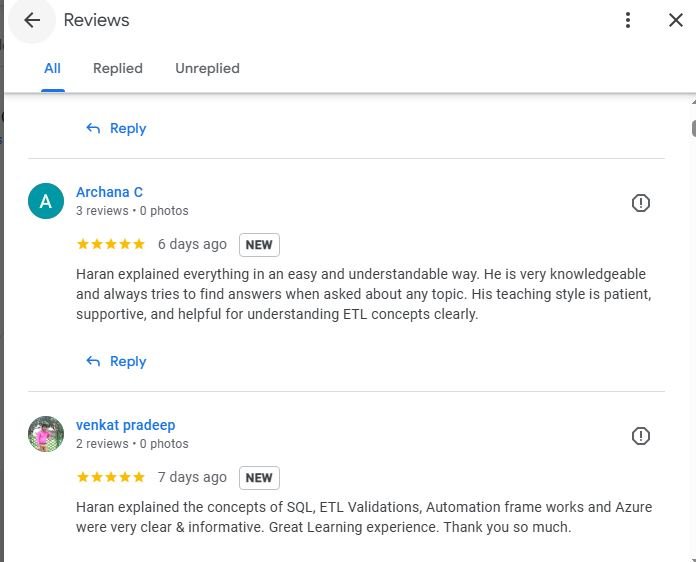
The instructor, Haran, is very knowledgeable in the ETL Testing course. We had highly interactive classes, which helped me gain knowledge and skills in SQL and Data warehouse concepts. He was always patient and willing to answer any questions we had, no matter how simple or advanced. The hands-on examples and real-world use cases were especially helpful for solidifying what I learned. The way is Teaching is good. Haran is repeating the concept with different set of examples until you are clear with that. Haran explained everything in an easy and understandable way. He is very knowledgeable and always tries to find answers when asked about any topic. His teaching style is patient, supportive, and helpful for understanding ETL concepts clearly. Haran explained the concepts of SQL, ETL Validations, Automation frame works and Azure were very clear & informative. Great Learning experience. Thank you so much. 👩 Fatima: 👨 Arjun Mehta: 👨 James Robinson: 👩 Sophia Rodriguez: 👨 Vamshi Krishna: |
Salient Features:
- 40 Hours of Live Training along with recorded videos
- One Year access to the recorded videos
- Course Completion Certificate
Who can enroll for this course?
- Manual Testers looking to move into ETL Testing & Automation
- ETL Testers who want to learn PySpark-based automation
- Automation Test Engineers interested in Data & Big Data Testing
- Data Engineers who want to strengthen their data validation and testing skills
- QA Professionals working on Data Warehouse or Cloud Data projects
- Freshers and Graduates interested in building a career in ETL Testing or Data Engineering
- Professionals planning to transition into Big Data Testing, Azure Data Engineering, or ETL Automation roles
- Anyone interested in learning real-time ETL Automation Framework Development using PySpark & Pytest.
Technologies Covered :
| Technology | Main Purpose |
| SQL | Data validation & reconciliation |
| SSIS | Traditional ETL testing |
| Azure Data Lake Storage Gen2 | File & data validation |
| Azure Data Factory | Cloud ETL pipeline testing |
| Databricks | Big-data processing validation |
| PySpark | Large-volume data validation |
| Python | ETL test automation |
| Pytest | Automated test execution |
| Power BI | Report & data validation |
What will I learn by the end of this course?
- Understand ETL processes and testing concepts.
- Validate SSIS ETL processes.
- Test Azure Data Factory pipelines.
- Validate files and data in Azure Data Lake Storage.
- Understand Databricks and PySpark processing.
- Perform source-to-target validation using SQL.
- Perform large-volume data validation using PySpark.
- Use Python to create reusable ETL validation utilities.
- Automate ETL test cases using Pytest.
- Validate Power BI data and reports.
- Build a reusable ETL automation testing framework.
- Execute an end-to-end ETL automation testing project.
Course syllabus:
MODULE 1 — ETL & SQL for Data Testers (5 Hours)
Objective
Understand ETL fundamentals and learn SQL-based validation techniques required for ETL testing.
- Introduction to ETL
- What is ETL?
- Why ETL is required
- ETL vs ELT
- ETL pipeline concepts
- Source, transformation and target concepts
- Batch processing
- Incremental processing
- ETL Tester responsibilities
- ETL Testing Fundamentals
- What is ETL testing?
- Source validation
- Transformation validation
- Target validation
- Data-quality validation
- Business-rule validation
- Functional testing
- Regression testing
- Smoke testing
- SQL Fundamentals for Data Testers
- SELECT
- WHERE
- DISTINCT
- ORDER BY
- GROUP BY
- HAVING
- CASE
- Aggregate functions
- NULL handling
- SQL Joins for ETL Testing
- INNER JOIN
- LEFT JOIN
- RIGHT JOIN
- FULL JOIN
- Self Join basics
- ETL Validation Queries
- Row count validation
- Duplicate validation
- NULL validation
- Primary-key validation
- Aggregate validation
- Source-to-target validation
- Missing-record validation
- Extra-record validation
- Advanced SQL for ETL Testing
- CTE
- Subqueries
- Window functions
- ROW_NUMBER
- RANK
- LEAD
- LAG
Hands-on
Create SQL queries for:
- Count validation
- Duplicate validation
- NULL validation
- Source-to-target reconciliation
- Transformation validation
MODULE 2 — SSIS ETL Testing (5 Hours)
Objective
Understand SSIS from a Data Tester perspective and perform complete SSIS ETL validation.
- Introduction to SSIS
- What is SSIS?
- Why SSIS is used
- SSIS packages
- Projects
- Control Flow
- Data Flow
- Important SSIS Components
- Execute SQL Task
- Data Flow Task
- Flat File Source
- OLE DB Source
- OLE DB Destination
- Lookup
- Derived Column
- Conditional Split
- Data Conversion
- Aggregate
- SSIS Variables & Parameters
- Variables
- Package parameters
- Project parameters
- Expressions
- Dynamic values
- SSIS ETL Testing
Validate:
- Source records
- Target records
- Record counts
- Column mapping
- Data types
- NULL values
- Duplicate records
- Lookup results
- Derived columns
- Business rules
- SSIS Incremental Load Testing
- Full load
- Incremental load
- Timestamp-based incremental load
- New records
- Updated records
- Duplicate processing
- Reprocessing scenarios
- SSIS Error & Reject Record Validation
- Error output
- Rejected records
- Invalid records
- Error tables
- Data-quality errors
- Validation of rejected records
Hands-on
Create an SSIS package and perform:
- Count validation
- Data validation
- Transformation validation
- Duplicate validation
- NULL validation
- Incremental-load validation
MODULE 3 — Azure Fundamentals for Data Testers ( 4 Hours)
Objective
Understand the Azure services required for ETL testing without going into unnecessary Azure administration topics.
- Introduction to Microsoft Azure
- What is Azure?
- Azure Portal
- Resource Groups
- Azure resources
- Azure Storage basics
- Azure Data Services for ETL Testing
- Azure Blob Storage
- Azure Data Lake Storage Gen2
- Azure Data Factory
- Azure Databricks
- Azure Data Lake Storage Gen2
- Storage accounts
- Containers
- Folders
- Files
- CSV files
- JSON files
- Parquet files
- Data Tester Activities in Azure
- File validation
- File availability validation
- File name validation
- File count validation
- File format validation
- File schema validation
- Data validation
- Record-count validation
- Azure Data Tester Concepts
- Understanding Azure-based ETL processes
- Source data validation
- Processed data validation
- Target validation
- Incremental data validation
- Data-quality validation
Hands-on
Perform basic file and data validations using Azure storage.
MODULE 4 — Azure Data Factory & ETL Pipeline Testing (6 Hours)
Objective
Learn how to test Azure Data Factory pipelines from a Data Tester perspective.
- Introduction to Azure Data Factory
- What is ADF?
- Why ADF is used
- ADF workspace
- Pipelines
- Activities
- Datasets
- Linked Services
- Integration Runtime
- ADF Activities
- Copy Data
- Lookup
- Get Metadata
- Stored Procedure
- Script
- Execute Pipeline
- ForEach
- If Condition
- Set Variable
- ADF Parameters & Variables
- Pipeline parameters
- Dataset parameters
- Variables
- Dynamic expressions
- Dynamic file names
- Dynamic paths
- ADF Pipeline Testing
Validate:
- Pipeline execution
- Activity execution
- Source data
- Target data
- File movement
- Record counts
- Data types
- Schema
- Data transformation
- ADF Copy Activity Testing
- Source validation
- Destination validation
- File validation
- Column mapping validation
- Data type validation
- Record count validation
- Data reconciliation
- ADF Incremental Load Testing
- Full load testing
- Incremental load testing
- Timestamp validation
- Watermark concept
- New record validation
- Updated record validation
- Duplicate processing validation
- ADF Parameter Testing
- Valid parameters
- Different parameter values
- Dynamic file paths
- Dynamic dates
- Multiple datasets
- Parameter-driven execution
Hands-on
Create and test an ADF pipeline involving:
- Source file
- Copy Activity
- Data Lake
- Parameter-driven execution
- Incremental processing
MODULE 5 — Python for ETL Test Automation (5 Hours)
Objective
Learn Python specifically for automating ETL testing.
- Python Fundamentals
- Variables
- Data types
- Strings
- Numbers
- Boolean
- Lists
- Tuples
- Sets
- Dictionaries
- Python Operators
- Arithmetic operators
- Comparison operators
- Logical operators
- Assignment operators
- Membership operators
- Control Flow
- if
- elif
- else
- for loop
- while loop
- break
- continue
- pass
- Python Functions
- Creating functions
- Parameters
- Arguments
- Return values
- Reusable functions
- File Handling
- Reading CSV
- Writing CSV
- Reading JSON
- Writing JSON
- Configuration files
- Python Exception Handling
- try
- except
- else
- finally
- Custom exceptions
- Python + SQL
- Database connectivity basics
- Execute SQL
- Fetch data
- Row-count validation
- Dynamic SQL
- Source-to-target comparison
- Python ETL Validation Functions
Create reusable functions:
- validate_count()
- validate_nulls()
- validate_duplicates()
- validate_schema()
- validate_data()
- validate_aggregate()
- Python Logging
- Logging basics
- INFO
- WARNING
- ERROR
- Validation logs
- Error logs
Hands-on
Develop a Python ETL validation utility that produces:
- Validation Name
- Expected Result
- Actual Result
- Status
- Error Message
MODULE 6 — Azure Databricks & PySpark ETL Testing (6 Hours)
Objective
Learn Databricks and PySpark specifically for large-volume ETL validation.
- Introduction to Azure Databricks
- What is Databricks?
- Why Databricks is used
- Databricks workspace
- Notebooks
- Clusters
- Jobs
- Tables
- Files
- Apache Spark Fundamentals
- What is Spark?
- Why Spark is used
- Driver
- Executors
- Tasks
- Jobs
- Stages
- DAG
- Lazy evaluation
- PySpark DataFrames
- Creating DataFrames
- Reading CSV
- Reading JSON
- Reading Parquet
- Schema inference
- Manual schema definition
- PySpark Transformations
- select
- filter
- where
- withColumn
- drop
- alias
- cast
- orderBy
- distinct
- dropDuplicates
- PySpark Joins
- Inner join
- Left join
- Right join
- Full join
- Lookup validation
- Join-result validation
- PySpark Aggregations
- groupBy
- count
- sum
- avg
- min
- max
- countDistinct
- ETL Validation Using PySpark
- Row count validation
- Column validation
- Schema validation
- Data type validation
- NULL validation
- Duplicate validation
- Data reconciliation
- Aggregate validation
- Derived-column validation
- Business-rule validation
- Delta Table Validation
- Delta tables
- Reading Delta tables
- Writing Delta tables
- Schema validation
- Data validation
- Basic time-travel concept
- Incremental Validation
- New records
- Updated records
- Deleted records
- Timestamp comparison
- Partition validation
- Snapshot comparison
- PySpark Performance Basics for Testers
- Partitioning basics
- Repartition
- Coalesce
- Cache
- Shuffle overview
- Broadcast join overview
Hands-on
Perform PySpark validations against large datasets:
- Count
- Schema
- NULL
- Duplicate
- Data Comparison
- Transformation
- Aggregate
MODULE 7 — Power BI Data & Report Testing (2 Hours)
Objective
Learn how Data Testers can validate Power BI reports and the underlying data.
- Introduction to Power BI Testing
- What is Power BI?
- Power BI Desktop
- Power BI Service
- Dataset
- Report
- Dashboard
- Visuals
- Power BI Data Validation
- Source-to-Power BI validation
- Record-count validation
- Column validation
- Data-type validation
- NULL validation
- Duplicate validation
- Aggregate validation
- Power BI Report Testing
Validate:
- Card values
- Tables
- Charts
- Filters
- Slicers
- Date filters
- Drill-down
- Drill-through
- Power BI Transformation Testing
- Power Query basics
- Data filtering
- Column transformations
- Derived columns
- Data type changes
- DAX Validation Basics
- Measures
- Calculated columns
- SUM
- COUNT
- DISTINCTCOUNT
- CALCULATE basics
- Power BI Reconciliation
Validate:
- Database values
- ETL output
- Power BI values
- Aggregates
- Business calculations
Hands-on
Validate a Power BI report against the underlying data using SQL.
MODULE 8— Pytest ETL Automation & End-to-End Project (7 Hours)
Objective
Build and execute a reusable ETL automation testing framework using Python, PySpark and Pytest.
Part A — Pytest Fundamentals
- Introduction to Pytest
- What is Pytest?
- Why Pytest for ETL testing?
- Test files
- Test functions
- Assertions
- ETL Test Cases
Create automated tests for:
- Count validation
- NULL validation
- Duplicate validation
- Schema validation
- Data validation
- Aggregate validation
- Business-rule validation
- Pytest Fixtures
- What is a fixture?
- Setup
- Teardown
- Reusable test setup
- Database connection fixture
- Spark session fixture
- Parameterization
- Parameterized test cases
- Multiple datasets
- Multiple validation rules
- Reusable test execution
- Pytest + SQL
- Execute SQL validations
- Capture query results
- Compare expected and actual results
- Assertions
- Failure messages
- Pytest + PySpark
- Execute PySpark validations
- Compare DataFrames
- Validate records
- Validate schemas
- Assertions
Part B — Reusable ETL Validation Framework
- Reusable Validation Functions
Develop reusable validators:
- Count Validator
- Duplicate Validator
- NULL Validator
- Schema Validator
- Reconciliation Validator
- Transformation Validator
- Aggregate Validator
- Business Rule Validator
- Test Execution
- Execute individual tests
- Execute multiple tests
- Execute complete test suite
- Run tests from command line
- Test execution options
- Test result analysis
- Logging
- Execution logs
- Validation logs
- Error logs
- Failed-test details
- Execution timestamps
- Test Reporting
- Test execution report
- PASS/FAIL status
- Failed validation details
- Failed-record capture
- HTML reporting
- Test summary
Part C — End-to-End ETL Automation Testing Project
Project Activities
Students will perform complete ETL testing involving:
- Source data validation
- SSIS ETL validation
- Azure Data Factory pipeline validation
- Azure Data Lake file validation
- Databricks data validation
- PySpark transformation validation
- SQL source-to-target reconciliation
- Python-based validation
- Pytest automation
- Power BI data validation
- Test reporting
Final Execution
Students will execute the complete set of automated ETL test cases and analyze:
- Passed tests
- Failed tests
- Validation results
- Error messages
- Failed records
- Execution logs
- HTML test reports
BONUS CONTENT — AI for ETL & Data Testing (2 Hours)
Objective
Introduce practical ways Data Testers can use AI tools to improve ETL testing, SQL validation, Python automation, and test-case preparation.
- Introduction to AI for Data Testing
- What is Generative AI?
- How AI can assist Data Testers
- Benefits of AI in ETL Testing
- Limitations of AI-generated test cases and code
- Importance of tester review and validation
- AI-Assisted ETL Test Case Generation
Use AI to generate test cases for:
- Source-to-target validation
- Row count validation
- Duplicate validation
- NULL validation
- Schema validation
- Data-type validation
- Transformation validation
- Business-rule validation
- Incremental-load testing
- AI-Assisted SQL Generation
Use AI to help create:
- SQL validation queries
- Count comparison queries
- Duplicate detection queries
- NULL validation queries
- Source-to-target reconciliation queries
- Aggregate validation queries
- Missing-record queries
- Extra-record queries
- Transformation validation queries
- AI-Assisted Python Automation
Use AI to assist with:
- Python validation scripts
- Reusable validation functions
- CSV/JSON processing
- Database connectivity code
- Exception handling
- Logging
- Pytest test cases
- Debugging Python errors
- AI-Assisted PySpark Testing
Use AI to help generate:
- PySpark DataFrame validation
- Schema validation
- Duplicate validation
- NULL validation
- Data comparison
- Transformation validation
- Aggregation validation
- PySpark test cases
- AI-Assisted ETL Defect Analysis
Use AI to analyze:
- SQL errors
- Python errors
- PySpark errors
- ETL validation failures
- Data mismatches
- Schema mismatches
- Duplicate records
- Transformation issues
- AI-Assisted Test Documentation
Use AI to generate:
- Test scenarios
- Test cases
- Test data ideas
- Expected results
- Defect descriptions
- Test execution summaries
- Test documentation
- Practical Hands-on Exercises
Students will use an AI tool to:
- Generate SQL validation queries
- Generate Python validation code
- Generate Pytest test cases
- Analyze a failed ETL validation
- Improve an existing validation script
- Generate additional negative test scenarios
Important Testing Principle
AI-generated output should never be accepted blindly.
The tester must:
- Review the generated SQL/code
- Verify the business logic
- Execute the query/script
- Compare results with expected results
- Correct AI-generated mistakes
- Protect sensitive project information
Live Sessions Price:
For LIVE sessions – Offer price after discount is 300 USD 259 89 USD Or USD13000 INR 12900 INR 6900 Rupees
OR
For any other details, Call me or Whatsapp me on +91-9133190573
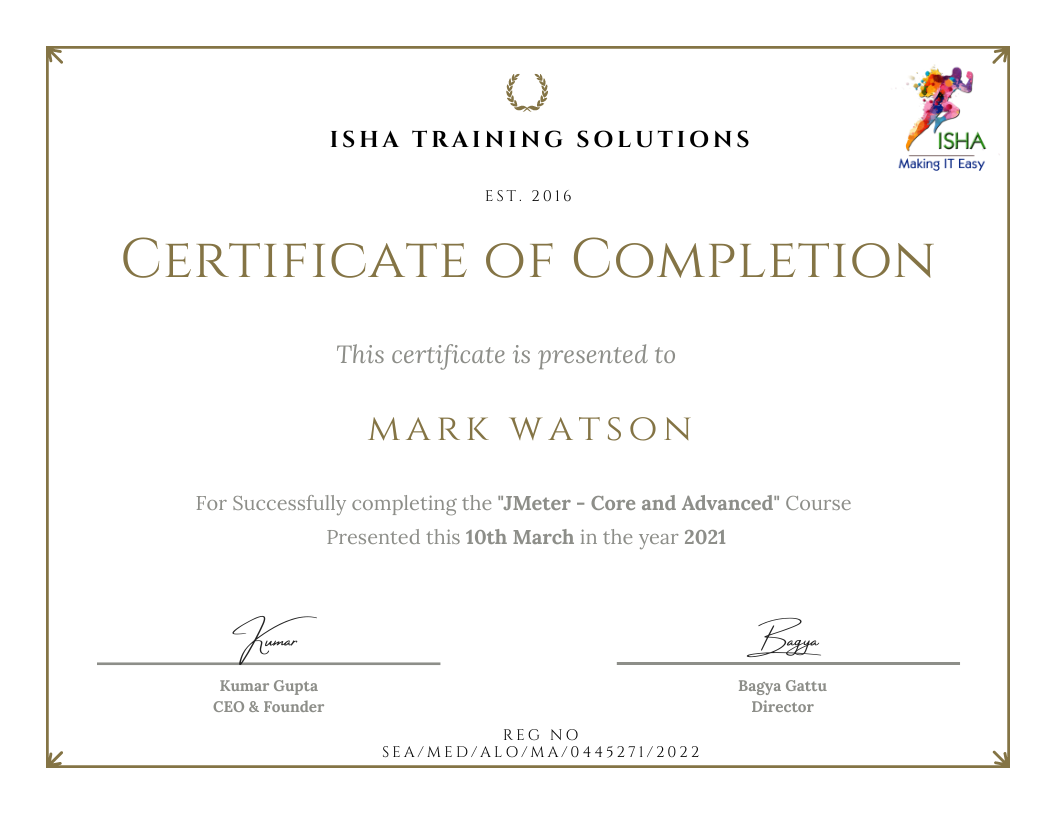
Sample Course Completion Certificate:
Your course completion certificate looks like this….
Important Note:
To maintain the quality of our training and ensure a smooth learning experience for all participants, we do not allow batch repetition or switching between courses.
To reiterate, moving from one course to another or shifting from one trainer to another (even if it is the same course) is not possible. Changing batches or trainers in any form is strictly not permitted.
We request all learners to attend the scheduled sessions regularly and make the most of their learning journey. Thank you for your understanding and continued support.
Reviews:
Course Features
- Lectures 78
- Quiz 0
- Duration 40 hours
- Skill level All levels
- Language English
- Students 1287
- Assessments Yes
- 9 Sections
- 78 Lessons
- 40 Hours
- MODULE 1 — ETL & SQL for Data Testers (5 Hours)6 ItemsObjective : Understand ETL fundamentals and learn SQL-based validation techniques required for ETL testing.
- MODULE 2 — SSIS ETL Testing (5 Hours)6 ItemsObjective : Understand SSIS from a Data Tester perspective and perform complete SSIS ETL validation.
- MODULE 3 — Azure Fundamentals for Data Testers ( 4 Hours)5 ItemsObjective : Understand the Azure services required for ETL testing without going into unnecessary Azure administration topics.
- MODULE 4 — Azure Data Factory & ETL Pipeline Testing (6 Hours)7 ItemsObjective : Learn how to test Azure Data Factory pipelines from a Data Tester perspective.
- MODULE 5 — Python for ETL Test Automation (5 Hours)9 ItemsObjective : Learn Python specifically for automating ETL testing.
- MODULE 6 — Azure Databricks & PySpark ETL Testing (6 Hours)10 ItemsObjective : Learn Databricks and PySpark specifically for large-volume ETL validation.
- MODULE 7 — Power BI Data & Report Testing (2 Hours)6 ItemsObjective : Learn how Data Testers can validate Power BI reports and the underlying data.
- MODULE 8— Pytest ETL Automation & End-to-End Project (7 Hours)21 ItemsObjective : Build and execute a reusable ETL automation testing framework using Python, PySpark and Pytest.
- 8.1Part A — Pytest Fundamentals : Introduction to Pytest
- 8.2Part A — Pytest Fundamentals : ETL Test Cases
- 8.3Part A — Pytest Fundamentals : Pytest Fixtures
- 8.4Part A — Pytest Fundamentals : Parameterization
- 8.5Part A — Pytest Fundamentals : Pytest + SQL
- 8.6Part A — Pytest Fundamentals : Pytest + PySpark
- 8.7Part B — Reusable ETL Validation Framework : Reusable Validation Functions
- 8.8Part B — Reusable ETL Validation Framework :Test Execution
- 8.9Part B — Reusable ETL Validation Framework :Logging
- 8.10Part B — Reusable ETL Validation Framework :Test Reporting
- 8.11Part C — End-to-End ETL Automation Testing Project : Project Activities
- 8.12Project Test Cases : TC01 — Row Count Validation
- 8.13Project Test Cases : TC02 — Duplicate Validation
- 8.14Project Test Cases : TC03 — NULL Validation
- 8.15Project Test Cases : TC04 — Schema Validation
- 8.16Project Test Cases : TC05 — Data Reconciliation
- 8.17Project Test Cases : TC06 — Transformation Validation
- 8.18Project Test Cases : TC07 — Aggregate Validation
- 8.19Project Test Cases : TC08 — Business Rule Validation
- 8.20Project Test Cases : TC09 — Incremental Load Validation
- 8.21Project Test Cases : TC10 — Power BI Data Validation
- BONUS CONTENT — AI for ETL & Data Testing (2 Hours)8 Items