Salesforce Data 360 30-Hour End-to-End Training Course – Live Training Demo
(30 Sessions | End-to-End Data 360 Implementation.)
A structured, hands-on journey through Salesforce Data 360 covering data ingestion, data modeling, identity resolution, insights, segmentation, activation, automation, advanced capabilities, and an end-to-end implementation project.
|
The trainer explains every concept in a very simple and clear way. Even complex topics were easy to understand – Harry I really enjoyed the training sessions. The trainer explained each topic clearly and patiently. The practical examples helped me understand how things work in real projects. Overall, it was a great learning experience. – Swati The training was very informative and practical. The trainer explained both basic and advanced concepts clearly. Real-time examples made the sessions more interesting. All our questions were answered patiently. The hands-on practice helped me understand the concepts better. I would definitely recommend this training to other professionals. – Vijay The trainer has excellent practical knowledge. Every concept was explained in a simple and structured way. I especially liked the real-time project examples. The trainer was always available to clarify our doubts. This training significantly improved my technical confidence. – Sara The training was very practical and easy to follow. The trainer explained complex topics step by step with real-time examples. I gained a lot of confidence from the sessions. – Matthew |
Who can enroll for this course:
- Salesforce Beginners: Those who want to understand Salesforce Data 360 fundamentals and architecture.
- Salesforce Administrators: Professionals interested in customer data management, data organization, and automation.
- Salesforce Developers: Developers who want to learn data integration, data modeling, and Data 360 implementation.
- CRM Professionals: People working with customer data across CRM and other business systems.
- Data Analysts: Professionals interested in customer insights, data segmentation, and business metrics.
- Marketing and Customer Experience Professionals: Those who want to understand customer profiles, audience segmentation, and data activation.
- Data Engineers and Integration Professionals: Those interested in connecting data sources, data ingestion, transformation, and integration workflows.
- AI and Agentforce Enthusiasts: Learners who want to explore how unified customer data supports RAG, Vector Search, and AI-powered solutions.
- Working Professionals: Individuals who want to upgrade their Salesforce and customer data management skills.
Prerequisites:
Basic knowledge of Salesforce, CRM concepts, or data management can be helpful, but the course starts with foundational concepts and progresses to advanced topics. Learners should be interested in Salesforce Data 360, data integration, customer insights, and practical implementation.
Salient Features:
- 30 Hours of Live Training along with recorded videos
- 1 Year Access to Session Recordings
- Course Completion Certificate
What will I learn by the end of this course?
- Understand Salesforce Data 360 architecture and the complete data lifecycle.
- Connect data sources and configure Data Streams for data ingestion.
- Work with Data Lake Objects (DLOs), Data Model Objects (DMOs), and data mapping.
- Organize data using Data Spaces and data model extensions.
- Configure Identity Resolution and create Unified Customer Profiles.
- Create Calculated Insights using SQL fundamentals and business metrics.
- Build customer segments using demographic and behavioral data.
- Configure segment activation and send data to supported destinations.
- Understand Data Actions, event-driven processes, and Data 360 automation.
- Explore Data Graphs, data enrichment, and advanced Data 360 capabilities.
- Understand AI concepts such as RAG, embeddings, Vector Search, and Hybrid Search.
- Learn how Salesforce Data 360 supports AI use cases with Agentforce.
- Build, validate, and troubleshoot an end-to-end Data 360 implementation.
- Apply your knowledge through practical exercises and a final implementation project.
By completing this course, you will gain practical knowledge to understand, configure, demonstrate, and troubleshoot Salesforce Data 360 solutions for real-world business use cases.
Course Syllabus:
Module 1 — Data 360 Foundation
Session 1 — Introduction to Data 360
- What is Data 360? — Understand how Data 360 brings data from different systems together to create
a connected customer view. - Why Data 360 is needed — Learn how fragmented data affects analytics, personalization, automation, and
AI. - Data 360 architecture — Understand the major components and how data moves through the platform.
- Key terminology — DLO, DMO, Data Stream, Data Space, Identity Resolution, Unified Profile, Calculated
Insight, Segment, Activation, and Data Action. - End-to-end lifecycle — Follow the journey from source data to business activation.
- Data → Unify → Understand → Act — Understand the four major stages.
Session 2 — Data 360 Architecture & Data Model
- Data 360 architecture — See how ingestion, storage, modeling, unification, insights, segmentation,
and activation work together. - Customer 360 Data Model — Learn the standardized structure used to represent customers and
related business information. - Standard vs Custom Data Model — Understand when standard objects or custom extensions are appropriate.
- Profiles and engagements — Distinguish customer identity from customer interactions.
- Object relationships — Understand how Individual, Contact Point, Product, Order, and Engagement
data connect.
Module 2 — Data Sources & Data Streams
Session 3 — Data Sources & Data Connections
- Data Sources — Understand where Data 360 receives information, including Salesforce, cloud
storage, databases, and external applications. - Data Connections — Learn how Data 360 connects to external systems.
- File-based data — Understand how CSV and similar files can be ingested.
- Batch vs Streaming — Understand periodic loads versus continuous/near-real-time data.
- Zero-copy / federated concepts — Learn the concept of accessing external data without copying all of it.
Session 4 — Data Streams
- What is a Data Stream? — Defines how data from a source enters Data 360.
- Data Stream lifecycle — Creation, configuration, mapping, deployment, ingestion, and monitoring.
- Source object selection — Select the appropriate source table/object.
- Data categories — Profile, Engagement, and Other.
- Data Space assignment — Understand where incoming data is logically organized.
- Deployment and monitoring — Activate the stream and verify ingestion.
Session 5 — Data Stream Hands-on
- Create a Salesforce/file-based Data Stream; configure source fields and data category.
- Configure ingestion behavior, deploy the stream, check ingestion status, validate records, and troubleshoot
common issues.
Module 3 — Data Lake Objects & Data Modeling
Session 6 — Data Lake Objects (DLOs)
- DLO — Stores ingested source data inside Data 360 before broader business modeling.
- Source fields and data types — Understand how source attributes and types are represented.
- Primary Key — Identifies individual records uniquely.
- Profile, Engagement, and Other DLOs — Understand their different purposes
Session 7 — Data Model Objects (DMOs)
- DMO — Provides a standardized business representation of data.
- Standard DMO — Salesforce-provided objects based on the Customer 360 Data Model.
- Custom DMO — Used when business data does not fit existing standard objects.
- DMO relationships — Understand how business entities connect.
- Unified DMO — Understand unified customer-level information after identity resolution
Session 8 — Data Mapping
- DLO → DMO mapping — Connect source data to the appropriate business object.
- Field mapping — Match source fields to target fields.
- Relationship mapping — Define connections between records.
- Primary and foreign keys — Understand record relationships.
- Mapping validation — Verify that data is interpreted correctly.
Session 9 — Data Preparation & Transformation
- Data quality — Identify inaccurate, incomplete, duplicate, or inconsistent data.
- Data cleansing and normalization — Standardize information before use.
- Transformation — Convert source data into the required target structure.
- Handling bad data — Understand downstream effects of invalid or incomplete records.
Session 10 — Data Explorer & Data Validation
- Data Explorer — Inspect Data 360 data.
- Record and field validation — Confirm expected records and values.
- Data lineage — Trace data through the pipeline.
- Troubleshooting — Identify ingestion, mapping, transformation, and relationship problems.
Module 4 — Data Spaces & Data Organization
Session 11 — Data Spaces
- Data Space — A logical boundary for organizing and separating Data 360 data and assets.
- Why Data Spaces are used — Support logical separation by business unit, region, or other requirements.
- Default and additional Data Spaces — Understand when additional spaces may be needed.
- Segmentation impact — Understand how Data Space selection affects available data.
Session 12 — Data Bundles & Data Model Extensions
- Data Bundles — Predefined collections of Data 360 metadata and model components.
- Standard mappings — Understand Salesforce-provided mapping structures.
- Custom extensions — Extend the standard data model with custom fields/objects.
- Data Kits — Understand reusable Data 360 configurations.
- Deployment considerations — Understand configuration dependencies.
Session 13 — Identity Resolution Fundamentals
- Identity Resolution — Determines which records from different sources represent the same real-world
person or entity. - Why it is required — The same customer may exist across CRM, ecommerce, service, and marketing
systems. - Source Profiles — Customer records coming from individual sources.
- Unified Individual / Profile — Consolidated customer representation after matching.
Session 14 — Identity Resolution Rulesets
- Ruleset — Defines how records are compared and consolidated.
- Match Rules — Specify attributes used to identify possible matches.
- Exact Matching — Values must match precisely.
- Fuzzy Matching — Allows controlled variations such as spelling differences.
- Normalized Matching — Compares standardized values.
- Reconciliation Rules — Determine which value is retained when sources disagree.
- Match keys and rule ordering — Control record comparison and how multiple rules work together.
Session 15 — Identity Resolution Hands-on
- Create a ruleset, configure matching and reconciliation, run the ruleset, review matched records, and analyze
unified records. - Consolidation rate — Understand how source records are consolidated into unified identities.
- Troubleshoot records that fail to match.
Module 6 — Calculated Insights
Session 16 — Calculated Insights Fundamentals
- Calculated Insight — A reusable calculation that derives business metrics from Data 360 data.
- Measures — Numerical results such as revenue, order count, or average spend.
- Dimensions — Attributes used to group results, such as customer, product, or region.
- Aggregations — SUM, COUNT, MIN, MAX, AVG, and similar calculations.
- Profile vs Population insights — Metrics for individual customers versus groups/populations
Session 17 — Calculated Insights Configuration & SQL
- Understand Calculated Insight structure, SQL fundamentals, SELECT, filters, JOINs, GROUP BY, aggregation,
measures, and dimensions. - Create a Calculated Insight and understand its object dependencies
Session 18 — Calculated Insights Hands-on
- Create practical insights such as customer revenue, order count, average order value, purchase frequency,
Customer Lifetime Value, engagement score, and last purchase date. - Validate and interpret the results.
Module 7 — Segmentation
Session 19 — Segmentation Fundamentals
- Segmentation — Creates groups of records that meet defined business criteria.
- Segment-on object — The primary entity on which a segment is built.
- Direct and related attributes — Use information from the segment-on object or related objects.
- Behavioral segmentation — Build audiences based on customer actions and interactions.
Session 20 — Building Segments
- Create a segment, select the segment-on object, add attributes, configure filters, and use AND/OR logic.
- Combine demographic and behavioral criteria, use related objects, preview results, and validate
membership.
Session 21 — Advanced Segmentation
- Calculated Insight segmentation — Use derived metrics as audience criteria.
- Nested segments — Use previously created segments where supported.
- Segment dependencies and membership — Understand how segmentation assets and qualifying
records relate. - Complex filter logic — Build advanced audiences for marketing, sales, service, personalization, and analytics.
Module 8 — Activation
Session 22 — Activation Fundamentals
- Activation — Sends a Data 360 audience or data to a destination where it can be used.
- Segment → Activation journey — Understand how an audience becomes actionable.
- Activation Membership — Determines which segment members are sent.
- Contact Points — Identify appropriate customer contact information.
- Batch vs Streaming Activation — Understand scheduled versus supported near-real-time activation.
Session 23 — Activation Destinations
- Salesforce activation — Send data into Salesforce environments.
- Marketing activation — Make audiences available for marketing use cases.
- Cloud storage and advertising destinations — Understand common downstream destination patterns.
- External destinations — Connect Data 360 information to supported external systems.
- Destination requirements — Understand destination-specific configuration needs.
Session 24 — Segment Activation Hands-on
• Select a segment, create an activation, select the destination, configure membership and contact points, apply filters, schedule the activation, and validate the destination data.
Module 9 — Data Actions & Automation
Session 25 — Data Actions
- Data Actions — Trigger actions when defined data events or changes occur.
- Event-driven architecture — Respond to relevant events instead of relying only on scheduled processes.
- Platform Events — Salesforce events for communicating between systems/processes.
- Webhooks — Notify external systems when configured events occur.
- Use cases — Personalization, notifications, service processes, and automated responses.
Session 26 — Data 360 Automation
- Automation — Connect Data 360 processes into repeatable workflows.
- Ingestion automation, Identity Resolution automation, Calculated Insight refresh, segmentation automation,
and activation automation. - Understand dependencies, monitoring, and troubleshooting of automated processes.
Module 10 — Advanced Data 360
Session 27 — Data Graphs & Data 360 Enrichment
- Data Graphs — Combine related information from multiple objects into a usable representation of a
customer or entity. - Graph relationships — Understand how related DMOs contribute to the graph.
- Data 360 enrichment — Add additional information to customer understanding.
- CRM consumption — Understand how Data 360 information can be surfaced for Salesforce users.
- Use cases — Service, personalization, sales intelligence, and AI.
Session 28 — Data 360, AI & Advanced Data Capabilities
- Data 360 and AI — Understand why unified, trusted data supports AI use cases.
- Unstructured data — Understand how documents and non-tabular information complement structured data.
- Chunking — Break documents into smaller pieces for processing.
- Embeddings — Represent content numerically for semantic comparison.
- Vector Search — Find information using semantic similarity.
- Hybrid Search — Combine keyword and semantic/vector search
- RAG — Retrieve relevant information before generating an AI response.
- Data 360 + Agentforce — Understand how trusted customer data provides context for AI agents.
Module 11 — End-to-End Implementation
Session 29 — Complete Data 360 Implementation
- Build an end-to-end solution: Source Data → Data Stream → DLO → DMO → Mapping & Transformation → Data Space → Identity Resolution → Unified Profile → Calculated Insight → Segment → Activation.
- Understand the purpose and dependency of each component and troubleshoot the pipeline when something
does not work.
Session 30 — Final Project, Troubleshooting & Revision
- Complete an end-to-end business use case.
- Review Data 360 architecture and troubleshoot Data Streams, mapping, Identity Resolution, unified records, Calculated Insights, segment filters, and activation.
- Review best practices, complete the final project discussion, and revise the full Data 360 lifecycle.
FAQ’s for Forward Deployed Engineer (FDE) Salesforce Course:
1. What is Salesforce Data 360?
Salesforce Data 360 unifies customer data from multiple sources to create a connected customer view.
2. Who can enroll in this course?
Salesforce professionals, developers, administrators, data analysts, and IT professionals can enroll.
3. What is the duration of the training?
The course includes 30 hours of end-to-end Salesforce Data 360 training.
4. What topics are covered in this course?
The course covers data ingestion, data modeling, Identity Resolution, segmentation, activation, automation, and AI capabilities.
5. Do I need prior Salesforce experience?
Basic knowledge of Salesforce and customer data concepts is helpful.
6. Will I learn about DLOs and DMOs?
Yes, you will learn Data Lake Objects, Data Model Objects, data mapping, and relationships.
7. What is Identity Resolution?
Identity Resolution identifies and combines records representing the same customer.
8. Will I learn Calculated Insights?
Yes, you will learn SQL concepts, aggregations, and customer business metrics.
9. Does the course cover segmentation and activation?
Yes, you will learn to build customer segments and activate data to supported destinations.
10. Will I learn about AI and Agentforce?
Yes, the course covers RAG, embeddings, vector search, and Data 360 integration with Agentforce.
11. Does the course include hands-on practice?
Yes, the course includes practical exercises and an end-to-end implementation project.
12. What will I learn by the end of the course?
You will learn to configure, implement, and troubleshoot a complete Salesforce Data 360 solution.
How can I enroll for this course?
OR
For any other details, Call me or Whatsapp me on +91-9133190573
Live Sessions Price:
For LIVE sessions – Offer price after discount is 200 USD 159 109 USD Or USD15000 INR 13000 INR 8900 Rupees.
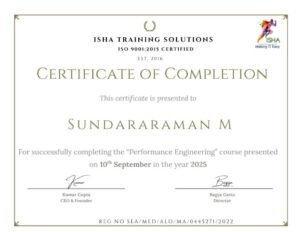
Sample Course Completion Certificate:
Your course completion certificate looks like this……
Course Policy :
Once payment is made, no refund will be provided.
If you do not attend the course, the payment cannot be transferred to another batch.
Course repetition is not allowed for missed sessions
We request all learners to attend the scheduled sessions regularly and make the most of their learning journey. Thank you for your understanding and continued support.