
AI & Machine Learning Engineering Master Program – Live Training
(From ML Foundations to Advanced Machine Learning, Deep Learning, Transformers, MLOps, Production Deployment, ML System Design and Hands-On Capstone Projects)
This AI & Machine Learning Engineering Course is designed to help you learn and master Machine Learning Engineering from fundamentals to advanced real-world implementation. You will build a strong foundation in AI, Machine Learning, Deep Learning, Linear Algebra, Calculus, Probability, and Statistics, while understanding the complete ML lifecycle.
The course covers supervised and unsupervised learning algorithms including Linear Regression, Logistic Regression, Naive Bayes, KNN, Decision Trees, Random Forest, XGBoost, LightGBM, SVM, and K-Means, along with essential concepts such as feature engineering, data cleaning, encoding, regularization, optimization, model evaluation, and cross-validation.
You will also learn Deep Learning and Neural Networks, including Perceptrons, MLPs, Backpropagation, CNNs, RNNs, LSTMs, GRUs, and Transformers. Hands-on implementation with Python, NumPy, and scikit-learn will help you apply concepts to practical machine learning problems.
To prepare you for real-world ML engineering environments, this program covers ML pipelines, experiment tracking, model and data versioning, model deployment with FastAPI, Docker, CI/CD, model monitoring, data drift, concept drift, and production ML systems.
You will also explore ML System Design, recommendation systems, research paper analysis, and end-to-end ML case studies, followed by a capstone project and mock review to demonstrate your practical skills.
About The Instructor:
|
Vishnu Priya is an AI & Machine Learning professional and trainer with 10+ years of industry experience in Artificial Intelligence, Machine Learning, Data Science, Python, Deep Learning, and Computer Vision. She has worked on practical AI/ML problems involving predictive modeling, machine learning algorithms, deep learning, and data-driven solutions, bringing valuable real-world experience to modern Machine Learning Engineering. She brings strong hands-on expertise across Python, Machine Learning, Data Science, Deep Learning, Neural Networks, Computer Vision, and predictive modeling. Her technical knowledge aligns closely with modern ML engineering practices, including data preprocessing, feature engineering, model development, evaluation, optimization, and practical machine learning implementation. She also has experience working with real-world ML projects, helping learners understand how theoretical concepts are applied to industry problems. With a strong passion for teaching, Vishnu Priya has 10+ years of professional experience and has trained 200+ students in AI, Machine Learning, Python, and related technologies. Her sessions focus on hands-on learning, practical implementation, real-world use cases, and simplifying complex technical concepts. She helps learners build their understanding progressively—from ML mathematics and algorithms to Deep Learning, Transformers, ML pipelines, deployment, MLOps, monitoring, and ML System Design. Her practical and learner-focused approach makes her well-suited to guide both beginners and experienced professionals preparing for careers in Machine Learning Engineering, AI Engineering, Data Science, and MLOps. |
Live Sessions Price:
For LIVE sessions – Offer price after discount is 200 USD 159 109 USD Or USD15000 INR 13000 INR 8900 Rupees.
OR
Free Demo Session:
25th August @ 9:00 PM – 10:00 PM (IST) (Indian Timings)
25th August @ 11:30 AM – 12:30 PM (EST) (U.S Timings)
25th August @ 4:30 PM – 5:30 PM (BST) (UK Timings)
Class Schedule:
For Participants in India: Monday to Friday @ 9:00 PM – 10:00 PM (IST)
For Participants in the US: Monday to Friday @ 11:30 AM – 12:30 PM (EST)
For Participants in the UK: Monday to Friday @ 4:30 PM – 5:30 PM (BST)
What student’s have to say about Trainer :
|
⭐ The course explains Machine Learning from the fundamentals in a very structured way. I especially liked the practical approach to ML algorithms, Deep Learning, and model deployment – Rahul Sharma ⭐ Excellent training! The concepts of Linear Algebra, Probability, and Machine Learning were explained very clearly– Priya ⭐ I joined this program to strengthen my Machine Learning Engineering skills. The modules on Transformers, MLOps, Docker, CI/CD, and ML deployment were extremely useful– Michael Anderson ⭐ One of the most comprehensive ML programs I have taken. It covers everything from ML foundations and algorithms to Deep Learning, deployment, monitoring, and ML system design. The hands-on approach and real-world examples made the concepts much easier to understand and apply. Highly recommended for anyone serious about becoming an ML Engineer. – Sneha ⭐Very practical and well-organized training. The instructor makes complex ML concepts easy to understand and connects theory with real-world applications. The capstone project was especially helpful.– Ayaan Khan |
What will I Learn by end of this course?
- Master ML Foundations & Mathematics – Understand AI, ML, Deep Learning, Linear Algebra, Calculus, Probability, and Statistics.
- Build & Evaluate ML Models – Work with Regression, Classification, Clustering, Decision Trees, Random Forest, XGBoost, SVM, and more.
- Apply Deep Learning Techniques – Build Neural Networks and understand CNNs, RNNs, LSTMs, GRUs, and Transformers.
- Prepare & Optimize Data – Perform data cleaning, feature selection, encoding, preprocessing, pipelines, and prevent data leakage.
- Deploy & Manage ML Models – Build APIs with FastAPI and use Docker, CI/CD, versioning, model registries, and experiment tracking.
- Build Production-Ready ML Systems – Understand ML lifecycle, monitoring, data/concept drift, ML system design, and complete an end-to-end capstone project.
Salient Features:
- 45 Hours of Live Training with real-time project demonstrations
- 1 Year Access to All Recorded Sessions for continuous learning and revision
- Industry-Recognized Course Completion Certificate upon successful completion
Who can enroll in this course?
- Aspiring ML Engineers looking to build strong foundations in Machine Learning and AI
- Software Developers & Python Developers transitioning into ML and AI engineering roles
- Data Scientists & Data Analysts wanting to strengthen their ML algorithms and engineering skills
- QA Engineers & SDETs looking to expand into AI/ML and intelligent automation
- DevOps & Cloud Professionals interested in ML deployment, Docker, CI/CD, and monitoring
- Professionals preparing for ML Engineer, AI Engineer, or MLOps Engineer roles seeking practical end-to-end expertise
Course syllabus:
- Artificial Intelligence
- Machine Learning
- Deep Learning
- AI vs ML vs DL
-
Types of ML
- Role of an ML Engineer
- ML Lifecycle
- Industry Applications
- Scalars
- Vectors
- Matrices
- Vector Operations
-
Dot Product
- Vector Norms
- NumPy Representation
- Matrix Addition & Multiplication
- Transpose
- Identity Matrix
- Matrix Inverse
- Matrix Rank
- Systems of Linear Equations
- NumPy Matrix Operations
- Eigenvalues & Eigenvectors
- Characteristic Equation
- Spectral Decomposition
- Variance & Covariance
- PCA Intuition
- PCA Workflow
- Explained Variance
- scikit-learn PCA
- Functions & Slopes
- Derivative
- Common Derivatives
- Product & Quotient Rules
- Chain Rule
- Partial Derivatives
- ML Connection
- Gradient
- Directional Intuition
- Jacobian
- Hessian
- Critical Points
- Multivariable Chain Rule
- Automatic Differentiation
- Probability Basics
- Conditional Probability
- Bayes Theorem
- Random Variables
- Probability Distributions
- Expectation
- Variance & Standard Deviation
- Independence
- Population vs Sample
- Descriptive Statistics
- Sampling
- Sampling Distribution
- Central Limit Theorem
- Confidence Intervals
- Hypothesis Testing
- p-value & Errors
- Objective Function
- MSE
- MAE
- Huber Loss
- Binary Cross-Entropy
- Categorical Cross-Entropy
- Loss vs Metric
- Choosing a Loss
- Optimization Landscape
- Gradient Descent
- Learning Rate
- Batch Gradient Descent
- Stochastic Gradient Descent
- Mini-batch Gradient Descent
- Convergence
- Implementation
- Momentum
- Nesterov Momentum
- AdaGrad
- RMSProp
- Adam
- Learning-Rate Scheduling
- Optimizer Comparison
- Artificial Intelligence
- Machine Learning
- Deep Learning
- AI vs ML vs DL
-
Types of ML
- Role of an ML Engineer
- ML Lifecycle
- Industry Applications
- Artificial Intelligence
- Machine Learning
- Deep Learning
- AI vs ML vs DL
-
Types of ML
- Role of an ML Engineer
- ML Lifecycle
- Industry Applications
- Artificial Intelligence
- Machine Learning
- Deep Learning
- AI vs ML vs DL
-
Types of ML
- Role of an ML Engineer
- ML Lifecycle
- Industry Applications
- Artificial Intelligence
- Machine Learning
- Deep Learning
- AI vs ML vs DL
-
Types of ML
- Role of an ML Engineer
- ML Lifecycle
- Industry Applications
- Artificial Intelligence
- Machine Learning
- Deep Learning
- AI vs ML vs DL
-
Types of ML
- Role of an ML Engineer
- ML Lifecycle
- Industry Applications
- Artificial Intelligence
- Machine Learning
- Deep Learning
- AI vs ML vs DL
-
Types of ML
- Role of an ML Engineer
- ML Lifecycle
- Industry Applications
- Artificial Intelligence
- Machine Learning
- Deep Learning
- AI vs ML vs DL
-
Types of ML
- Role of an ML Engineer
- ML Lifecycle
- Industry Applications
- Artificial Intelligence
- Machine Learning
- Deep Learning
- AI vs ML vs DL
-
Types of ML
- Role of an ML Engineer
- ML Lifecycle
- Industry Applications
- Artificial Intelligence
- Machine Learning
- Deep Learning
- AI vs ML vs DL
-
Types of ML
- Role of an ML Engineer
- ML Lifecycle
- Industry Applications
- Artificial Intelligence
- Machine Learning
- Deep Learning
- AI vs ML vs DL
-
Types of ML
- Role of an ML Engineer
- ML Lifecycle
- Industry Applications
- Artificial Intelligence
- Machine Learning
- Deep Learning
- AI vs ML vs DL
-
Types of ML
- Role of an ML Engineer
- ML Lifecycle
- Industry Applications
- Artificial Intelligence
- Machine Learning
- Deep Learning
- AI vs ML vs DL
-
Types of ML
- Role of an ML Engineer
- ML Lifecycle
- Industry Applications
- One thread = one virtual user
- -Xms / -Xmx heap sizing
- jmeter.properties vs user.properties
-
Lab: Configure JVM & Run First Non-GUI Test
- Execution order: Pre → Sampler → Post → Assert
- Thread Group / Sampler / Controller / Listener
- Config Elements & scope rules
-
Lab: Build a 3-Request Test Plan from Scratch
- Proxy recorder setup (port 8888)
- HTTPS certificate installation
- Filtering CSS / JS / images
- Lab: Record a Login Flow
Session 5: Thread Groups & Load Shape Basics
Thread count, ramp-up, duration, think time, and the throughput vs concurrency mental model.
- Thread count vs Ramp-up vs Duration
- Loop Count vs Scheduler
- Constant / Uniform / Gaussian Timer
- Lab: Ramp 100 Users Over 5 Minutes
Phase 2: Scripting Mastery (incl. Groovy Deep-Dive) (Sessions 6–14 · Build production-grade, parameterised, correlated scripts — with full Groovy mastery)
- Regular Expression Extractor
- JSON Extractor (JSONPath / JMESPath)
- XPath 2.0 · Boundary Extractor
- Lab: Correlate a JWT Token
Session 7: Parameterisation & Data-Driven Testing
CSV Data Set Config, sharing modes, recycle strategies, and built-in functions for unique data.
- CSV Data Set Config — all options
- Sharing modes: All Threads / Thread
- __RandomString · __UUID · __counter
- Lab: 500-User Login with Unique Credentials
Session 8: Assertions & Validation
- Response Assertion
- JSON Assertion
- Duration Assertion (SLA enforcement)
- JSR223 Assertion (Groovy)
- Lab: Validate API Response Schema
Session 9: Controllers — Logic & Flow
- If · While · Loop Controller
- Transaction Controller
- Throughput Controller (traffic splits)
- Lab: Simulate Browse → Cart → Checkout
- JSR223 PreProcessor (Groovy)
- JSR223 PostProcessor
- HTTP Header Manager · Cookie Manager
- Lab: Dynamic Auth Header per Request
- def / GString / GDK methods
- vars · props · log · prev · ctx · sampler
- collect · findAll · inject · each
- ?. operator · Elvis ?: · null safety
- Lab: Groovy String & Collection Workout
- HttpURLConnection from Groovy
- HMAC-SHA256 + Base64 signing
- File.text · readLines · append
- Compiled script caching — static vars only
- Lab: HMAC-SHA256 Request Signing
- Token refresh on 401 via If Controller
- JsonBuilder — nested dynamic payloads
- JsonSlurper schema validation
- AtomicInteger error budget counter
- Lab: Auto Token Refresh on 401
- HTTP verbs: GET POST PUT PATCH DELETE
- GraphQL over HTTPOAuth 2.0 client_credentials & password grant
- Lab: Full CRUD Test
- Summary vs Aggregate Report
- JTL file — every column explained
- HTML Dashboard Report
- Lab: Generate Full HTML Report from JTL
- jmeter -n -t -l -e -o
- -Jpropname=value runtime overrides
- ${__P(propname, default)}
- Lab: Parameterise Test via CLI
- RMI port & remote_hosts config
- CSV partitioning across workers
- Result aggregation
- Lab: 3-Worker Distributed Test
- P90 / P95 / P99 — which to use when
- Throughput plateau = saturation signal
- Apdex score · Concurrency curve
- Lab: Identify the Saturation Point
- Backend Listener → InfluxDB
- Grafana dashboard ID 5496
- Alert rules on P95 breach
- Lab: Live Dashboard During 1000-User Test
- GC pause correlation with P99 spikes
- DB connection pool exhaustion pattern
- Kibana + ELK log correlation
- Lab: Correlate P99 Spike with GC Full Event
- Concurrency Thread Group (JP@GC)
- Arrivals Thread Group (RPS-based)
- Throughput Shaping Timer · Flash-sale patterns
- Lab: Model a Flash Sale Traffic Spike
- JMeter Plugin Manager
- WebSocket Sampler
- JDBC Request Sampler + Connection Config
- Lab: 200-User Database Read Load Test
- Flat vs waterfall latency signatures
- Thread dump analysis
- GC log — G1GC pause patterns
- Lab: RCA on a Deliberately Broken App
- JMeter Dockerfile
- Docker Compose: master + 3 workers
- JMeter on Kubernetes — ephemeral workers
- Lab: 5000-User Test via K8s Cluster
- NFR gathering template
- Executive summary: one page, clear verdict
- Pass/fail criteria framing
- Lab: Write a 1-Page Executive Summary
- Jenkins Performance Plugin
- Jenkinsfile declarative pipeline
- errorFailedThreshold · relativeFailedThresholdPositive
- Build trend analysis across 10 builds
- Lab: Jenkinsfile with Performance Gate
- GitHub Actions — full perf.yml workflow
- Matrix strategy: dev / staging / prod in parallel
- PR comment via GitHub API
- Azure DevOps · GitLab CI
- Lab: GitHub Actions PR Comment with P95 Result
- Promotion gate: block staging→prod on SLA breach
- Parallel sharding across CI agents
- Nightly cron soak test (8-hour schedule)
- Slack webhook notifications
- Lab: Slack Notification on Test Completion
- OneAgent · ActiveGate · Smartscape
- PurePath — end-to-end distributed trace
- Test annotation API: POST /api/v1/events
- x-dynatrace header linking requests to PurePaths
- Lab: Annotate a JMeter Test Run in Dynatrace
- Davis AI — automatic anomaly detection
- GET /api/v2/problems — real-time querying
- Smartscape topology-aware impact analysis
- Auto-abort test on HIGH problem via Groovy
- Lab: Auto-Abort Test on Dynatrace HIGH Problem
- Full pipeline: commit → test → gate → notify → promote
- Dynatrace SLO-based quality gate
- Metrics API v2: service response time SLO
- Pipeline as evidence for change advisory record
- Lab: End-to-End JMeter + Dynatrace Gate
- 3-environment test strategy with Dynatrace SLOs
- Groovy HMAC signing + auto token refresh + error budget
- Distributed (3 workers) + Grafana live + DT annotated
- CI/CD: Jenkins + GitHub Actions + DT problems gate
- Executive report + Slack notification + 10-slide deck
How can I enroll for this course?
OR
For any other details, Call me or Whatsapp me on +91-9133190573
Live Sessions Price:
For LIVE sessions – Offer price after discount is 200 USD 159 109 USD Or USD15000 INR 13000 INR 8900 Rupees.
FAQ –Apache JMeter Performance Testing Course with CI/CD, Dynatrace & Grafana:
1️⃣ What is this AI & Machine Learning Engineering course about?
This course provides end-to-end training in Machine Learning Engineering, covering ML fundamentals, mathematics, algorithms, deep learning, Transformers, data preprocessing, model evaluation, deployment, MLOps, monitoring, and ML system design.
2️⃣ Do I need prior Machine Learning experience?
No. The course starts with AI, ML, Deep Learning, Linear Algebra, Calculus, Probability, and Statistics, making it suitable for learners who want to build their ML foundation before moving to advanced concepts.
3️⃣ What programming language will be used?
The course primarily uses Python along with tools and libraries such as NumPy and scikit-learn for implementing machine learning concepts and models.
4️⃣ What Machine Learning algorithms will I learn?
You will learn Linear Regression, Polynomial Regression, Logistic Regression, Naive Bayes, KNN, Decision Trees, Random Forest, XGBoost, LightGBM, SVM, K-Means, and other important ML algorithms.
5️⃣ Does the course include real-world projects?
Yes. The program includes ML case studies, recommendation system concepts, ML system design, production considerations, and an end-to-end capstone project covering data preparation, modeling, evaluation, packaging, serving, and monitoring.
6️⃣ Is there a capstone project?
Yes. The course concludes with a capstone project and mock review, where you work through an ML workflow including data pipeline, baseline modeling, evaluation, packaging, deployment, and monitoring planning.
7️⃣ What career roles can this course help me prepare for?
The course can help learners build skills relevant to roles such as Machine Learning Engineer, AI Engineer, ML Engineer, MLOps Engineer, Data Scientist, and AI/ML Developer.
8️⃣ Is this course suitable for working professionals?
Yes. The course is designed to provide a structured path from ML fundamentals to production engineering, making it suitable for professionals looking to transition into or advance their careers in AI and Machine Learning.
9️⃣ What career opportunities can I pursue after this course?
You can apply for roles such as Performance Test Engineer, Performance Engineer, QA Engineer, SDET, DevOps Engineer, and Site Reliability Engineer (SRE).
🔟 Will I get support after the training?
Yes. You will receive mentor support, guidance for practical exercises, and assistance with your learning throughout the course.
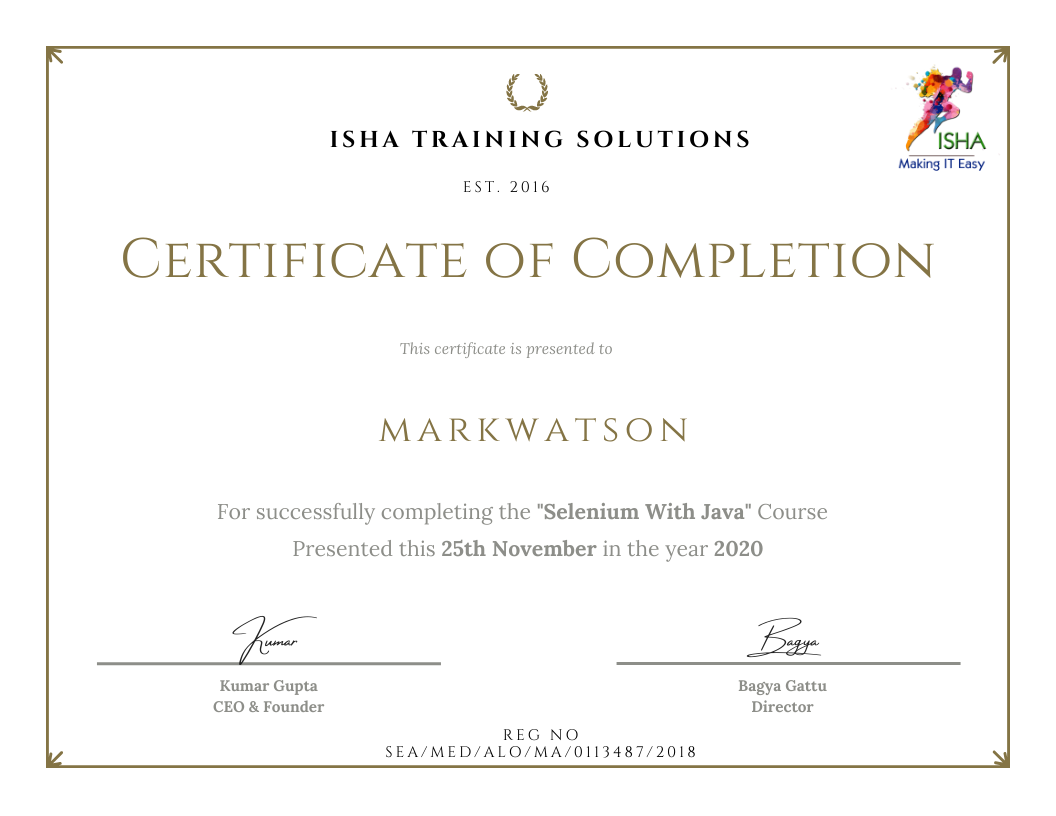
Sample Course Completion Certificate:
Your course completion certificate looks like this……
Note:
To maintain the quality of our training and ensure a smooth learning experience for all participants, we do not allow batch repetition or switching between courses.
To reiterate, moving from one course to another or shifting from one trainer to another (even if it is the same course) is not possible. Changing batches or trainers in any form is strictly not permitted.
We request all learners to attend the scheduled sessions regularly and make the most of their learning journey. Thank you for your understanding and continued support.
Course Features
- Lecture 0
- Quiz 0
- Duration 10 weeks
- Skill level All levels
- Language English
- Students 0
- Assessments Yes